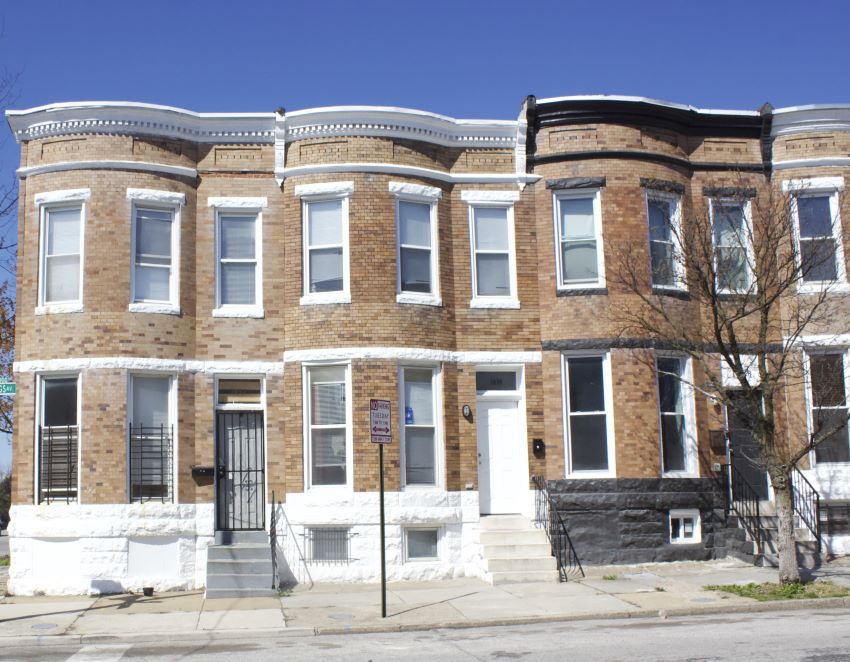
Photo credit:
Jacqueline Shin, 03/29/2024
|
Midtown Edmondson Historic District
Inventory No.:
B-5118
Date Listed:
2/20/2025
Location:
Baltimore, Baltimore City
Category:
District
Period/Date of Construction:
1888-1965
Boundary Description:
The Midtown Edmondson Historic District boundaries are the rear lot line of N. Fulton Avenue, which defines the boundary of the Old West Baltimore Historic District (B-1373) on the east; U.S. Route 40/W. Franklin Street on the south, between N. Fulton and the Northeast Corridor (NEC) railroad bridge; N. Bentalou Street on the west, which forms the eastern boundary of the Edmondson Avenue Historic District (B-5187); and the NEC railway line on the west and north. The district boundaries extend west of the railway line at Edmondson Avenue to include 2249, 2237, 2235, and 2140 Edmondson Avenue, in order to incorporate the extension of the district's commercial/industrial corridor over the railroad tracks. The western boundary of the district parallels the NEC between Edmondson Avenue and W. Lafayette Avenue. The boundaries extend west of the railway line at W. Lafayette Avenue to include 2200 and 2120 W. Lafayette, and 2101 Riggs Avenue. The northern boundary of the district continues paralleling the railway on the northeast from W. Lafayette Avenue, along Winchester Street, to McKean Avenue. The eastern boundary of the district is formed by the rear property lines of the rowhouses and churches facing on N. Fulton Avenue, between Winchester Street to the north and W. Franklin Street to the south.
|
|
Description:
The Midtown Edmondson Historic District is a mixed-use area of rowhouses, warehouses, commercial, and religious buildings largely constructed between the 1890s and 1910s. The district is characteristic of the transition between Baltimore’s early period
|
Significance:
of suburban growth through the 1890s, and a later period of development from the 1910s through the 1940s.
Reflecting this suburban development, the district has local significance for its history of streetcar suburbanization and its association with the growth of West Baltimore, as well as for its association with the post-WWII racial transition of West Baltimore from exclusively white to predominantly African American. The district is further eligible as a local example of a late 19th�and early 20th-century suburb with a range of rowhouse design.
|
|
