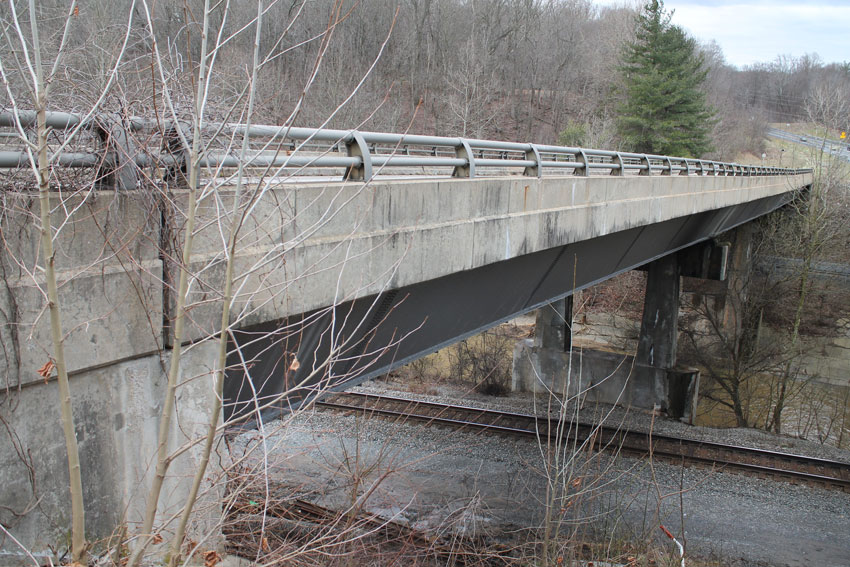
Photo credit:
Gerald M. Kuncio, 2/24/2016
|
Sykesville Bypass Bridge
Inventory No.:
HO-673
Other Name(s):
SHA Bridge No. 1304600, Aluminum Bridge
Date Listed:
12/6/2024
Location:
Sykesville Road (MD 32) over River Road, the South Branch of the Patapsco River, and CSX Railroad, Sykesville, Howard County
Category:
Structure
Period/Date of Construction:
1962-1963
Architect/Builder:
Harry Kahn (Lead Designer), Kinetics Division, Fairchild Engine and Airplane Corporation; Maryland State Roads Commission
Related Multiple Property Record:
Historic Highway Bridges of Maryland, 1694-1965
|
|
Description:
The Sykesville Bypass Bridge is an abandoned three-span, 293 foot long, 35-foot-wide structure spanning River Road, the South Branch of the Patapsco River, and tracks of the CSX Railroad on the boundary of Howard and Carroll counties. The superstructure of the bridge is composed of triangular box girders constructed from an aluminum alloy. Each individual girder beam has a structural depth of 67 inches and a width of seven feet. The girders are built in a fashion similar to an airplane wing, employing the principles of semi-monocoque construction, meaning that each beam has a skin which is braced with stiffeners for additional strength. A bottom cover or plate of aluminum is attached to each beam and serves as a tension area of the cross section. In profile, the spans resemble trapezoids, with the widest plane on the top. The superstructure is supported by a reinforced concrete substructure of two reinforced concrete piers and two reinforced concrete abutments. The superstructure is topped by a reinforced concrete deck.
|
Significance:
The Sykesville Bypass Bridge is significant example of bridge engineering. It is the only aluminum bridge constructed in Maryland and one of only seven constructed in North America. The unique aluminum triangular box girder design, developed by the Kinetics Division of Fairchild Engine and Airplane Corporation of Hagerstown, represents an innovative attempt to incorporate lightweight aluminum girders in place of the usual steel or reinforced concrete girders in order to minimize dead load without lessening live load capacity. The use of semi-monocoque construction, a concept developed in airplane design, provided strength while using much less material than similarly sized steel or concrete girders. The corrosion-resistant properties of aluminum also greatly reduced maintenance costs, as the beams did not have to be painted. At 293 feet, the Sykesville Bypass Bridge is the longest aluminum triangular box beam girder bridge ever built and one of only three such bridges ever constructed in this country.
|
|
