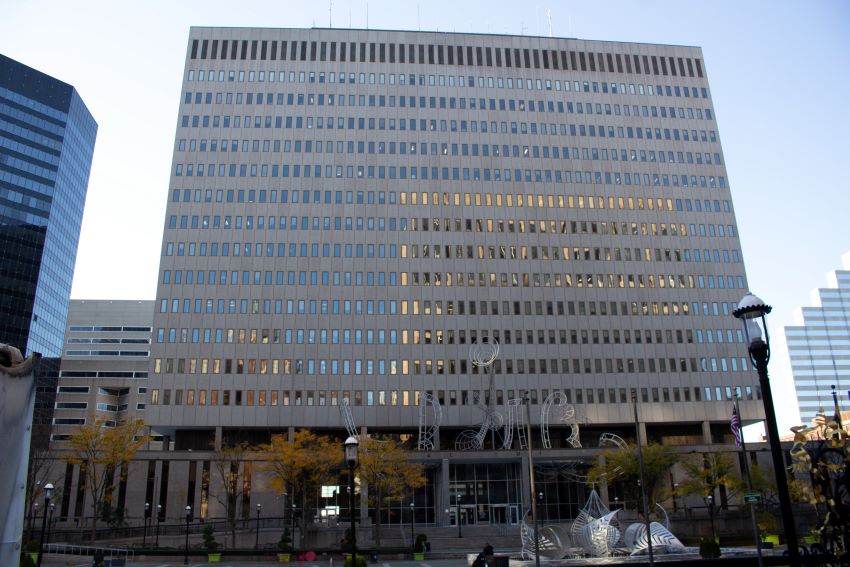
Photo credit:
Carol Highsmith, 9/20/2018
|
Federal Office Building
Inventory No.:
B-5286
Other Name(s):
George H. Fallon Federal Office Building
Date Listed:
11/15/2023
Location:
31 Hopkins Plaza, Baltimore, Baltimore City
Category:
Building
Period/Date of Construction:
1963-1967
Architect/Builder:
Fisher, Nes, Campbell, and Associates (lead architects); Fenton and Lichtig (associate architects); Office of James R. Edmunds, Jr. (associate architects)
Boundary Description:
The boundaries correspond to those of current Lot 024, Block 0601, Section 10, Tax Map 0004. The Mayor and City Council of Baltimore transferred the property to the United States of America on May 1, 1963, and it is described in Liber JFC-1477, Folio 334 of the land
records of Baltimore City.
|
|
Description:
Located in downtown Baltimore, Maryland, the Federal Office Building was developed by the United States General Services Administration (GSA) and completed in 1967. The International-Style high-rise office building was designed by the Baltimore architectural firm of Fisher, Nes, Campbell, and Associates, in collaboration with the firms Fenton and Lichtig and James R. Edmunds, Jr. of Baltimore. The seventeen-story, rectangular-plan building is of steel frame and reinforced concrete construction with an exterior clad in panels of Coldspring Rockville Granite, from quarries near Coldspring, Minnesota. Containing approximately 725,978 gross square feet of space, the high-rise office building exhibits a three-part composition, consisting of a wide base, pedestal, and tower. The base, which measures 480 feet long by 223 feet wide, comprises the ground floor, basement, and sub-basement. Located in the sub-basement and part of the basement levels are underground parking garages accommodating approximately 289 vehicles. At street level, the granite-clad base fronts the public sidewalk on its south and west sides and varies in height due to the sloping nature of the site, with the basement level exposed at the east end, along Lombard Street. The base features ground-floor windows along its south elevation, in addition to pedestrian and vehicular garage entrances. In the north and west elevations, sets of wide granite steps pierce the base, providing access to the plaza that wraps around the building at the first-floor level. Rising from the plaza, and situated above street level, the pedestal, measuring 392 feet long by 152 feet wide, contains floors one and two and the building’s main entrance and lobby. The upper sixteen floors form the tower, measuring 273 feet long by 93 feet wide. In total, the building stands approximately 269 feet tall, measured from the first-floor level to the roof.
|
Significance:
The Federal Office Building was designed and constructed during the postwar period, an era of growth for the federal government that was concurrent with initiatives aimed at improving the quality of federal architecture. After World War II, the newly created GSA undertook a nationwide building campaign to address the office space and facilities requirements of federal agencies and programs. As part of this effort to modernize federal facilities, GSA developed functional, architecturally modern office buildings, courthouses, and post offices in cities and towns across the U.S. After 1962, matters of federal design were influenced by the Guiding Principles for Federal Architecture, created by an ad-hoc committee appointed by President Kennedy to improve the quality of new government buildings. The Federal Office Building was developed as part of Charles Center, a major urban renewal project that was planned and implemented between 1955 and 1975. Charles Center, a mixed-use development project sited on three superblocks in downtown Baltimore, was one of the earliest and most nationally recognized urban renewal projects of its kind in the country. When the Federal Office Building was completed in 1967, it was hailed as the southwest anchor of Charles Center. The Center contained over 2,000,000 square feet of office space, in addition to apartments, retail, hotels, three public plazas linked by pedestrian walkways, and a theater, and was a significant economic catalyst that contributed to the postwar revival of downtown Baltimore. Architecturally, the Federal Office Building is a locally significant example of an International- Style, high-rise office tower, one of several modernist buildings in Charles Center that heralded the arrival of postwar modernism in Baltimore’s central business district. With its planar, rectilinear qualities, regular ordering of design elements, and clean expression of materials versus applied ornament, the Federal Office Building embodies the defining characteristics of the International Style.
|
|
