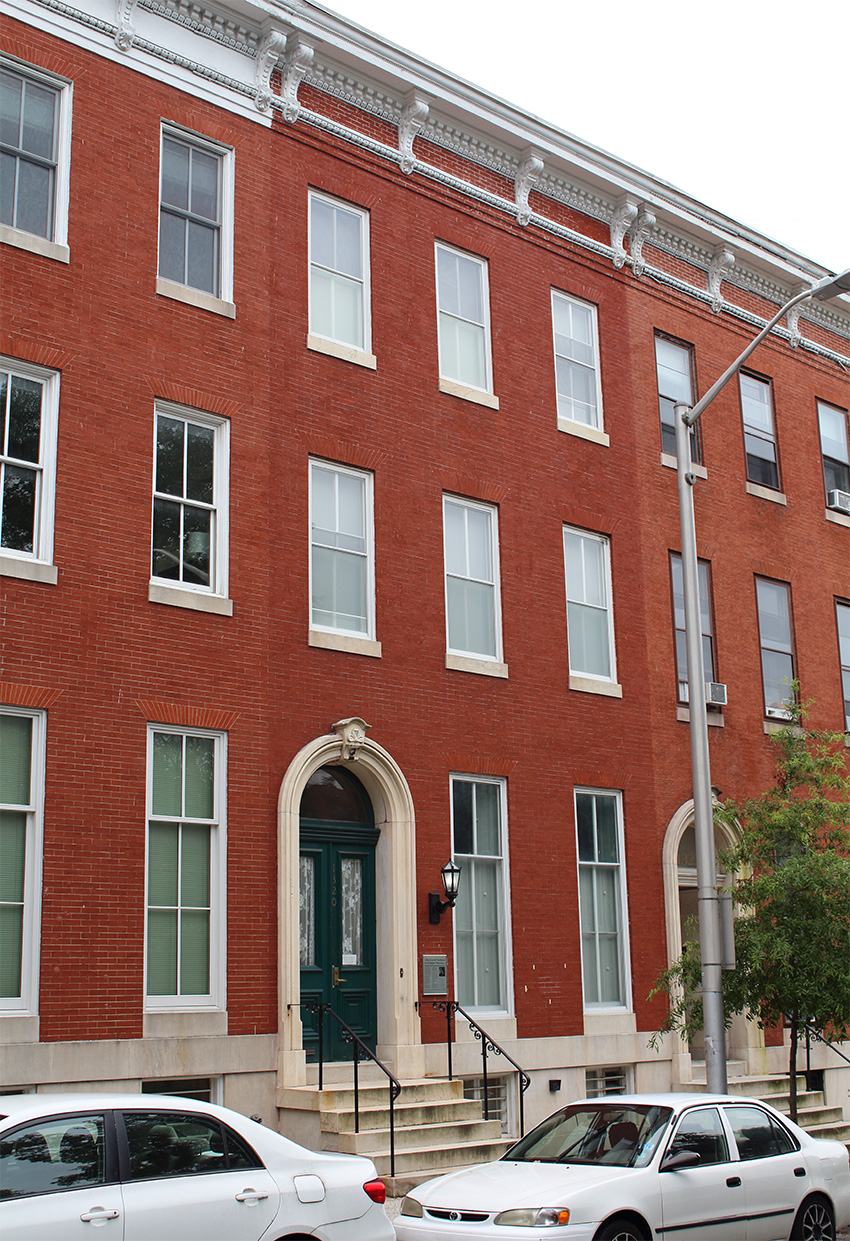
Photo credit:
Nicole A. Diehlmann, 08/2020
|
Lillie Carroll Jackson House
Inventory No.:
B-853
Date Listed:
4/13/2023
Location:
1320 Eutaw Place, Baltimore, Baltimore City
Category:
Building
Period/Date of Construction:
1953-1970
Boundary Description:
The property is known as 1320 Eutaw Place and consists of the Baltimore City tax parcel Ward 11, Section 06, Block 0399, Lot 010.
Related Multiple Property Record:
Civil Rights in Baltimore, Maryland, 1831-1976
|
|
Description:
The Lillie Carroll Jackson House in Baltimore, Maryland, is a beautifully restored circa-1868 brick rowhouse in the Bolton Hill Historic District (B-64). The property lies on the southwest side of Eutaw Place, a divided boulevard with a landscaped median containing mature trees, walking paths, and statuary. The surrounding blocks contain three- and four-story rowhouses in brick, brownstone, marble, and granite. Late-nineteenth- and early-twentieth-century churches, synagogues, schools, and public buildings are interspersed. The three-story, 5,016-square-foot rowhouse with a raised basement is built to the property line and has a northeastern façade with three bays. Paired doors are set within a limestone-trimmed, arched opening that is accessed by granite and marble steps. Most windows are two-over-two with marble sills and jack arch lintels. A bracketed Italianate-style cornice caps the façade. The southwest (rear) elevation contains a two-story oriel window on the second and third stories. A one-story, early-twentieth-century brick garage and courtyard sit southwest of the house and are accessed by Morris Street. The nominated property contains two contributing resources: the house and the garage.
|
Significance:
The house is being nominated under Criterion B, for its association with Lillie Carroll Jackson, at the local level of significance. It meets the requirements of “Properties Associated with Prominent Persons,” outlined in the “Civil Rights in Baltimore, Maryland, 1831-1976” Multiple Property Submission, and was identified in this document as an individually eligible resource. The period of significance begins with Lillie Carroll Jackson’s purchase of the property in 1953 and ends in 1970 when she resigned as president of the Baltimore NAACP.
|
|
