Photo credit:
Ken Short, 2021/2022
|
Etowah
Inventory No.:
AA-154
Date Listed:
12/19/2022
Location:
4056 Solomons Island Road (MD 2), Harwood, Anne Arundel County
Category:
Building
Period/Date of Construction:
c.1820-1950
Architect/Builder:
Archibald Coleman Rogers (Addition)
Boundary Description:
The eastern boundary is the dirt farm lane that runs generally north-south, to the east of the house, beginning at the intersection with another farm lane that runs generally east-west, to the south of the house. The eastern boundary runs north for approximately 450 feet. The southern boundary follows the farm lane westward for 500 feet to a tree line bordering a farm field. The western boundary runs along the curving edge of this field, following the tree line north for 450 feet. The northern boundary parallels the southern boundary, running approximately 500 feet from the farm lane on the east to the farm field border on the west, though a generally wooded portion of the farm.
|
|
Description:
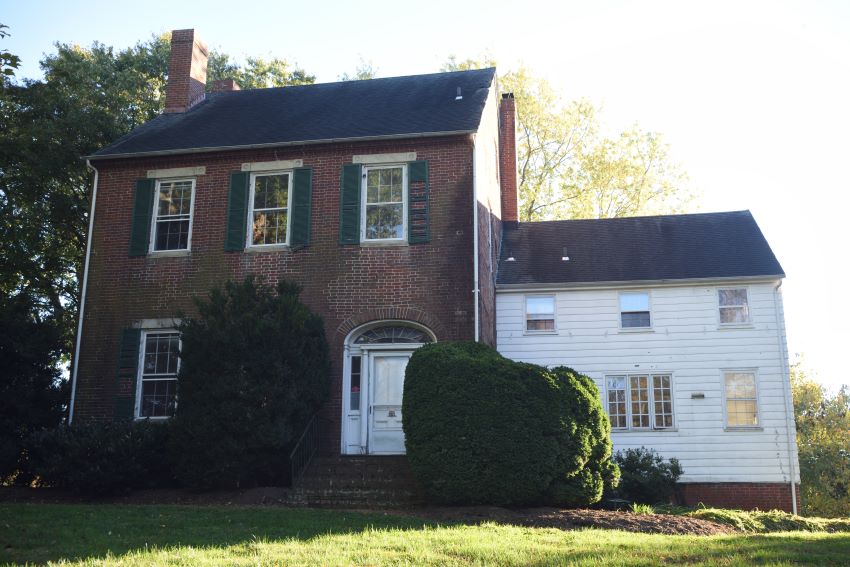
Sited on 95 acres of land, Etowah is located about 1.5 miles northeast of Harwood in southern Anne Arundel County. The main house is comprised of two sections: the original section, dating to ca. 1820 to 1830, is constructed of brick and stands three bays wide and two stories tall. Its façade is laid in Flemish bond, and its interior is organized in the side-passage, double-pile plan popular in the region during this period, featuring refined Federal-style detailing. A frame wing was added ca. 1949 in the then-popular Colonial Revival style, complementing the motifs of the brick house. Etowah faces north on the west side of the drive, which loops in a half circle back to the road. Also on the property are an early nineteenth-century, one-story, square outbuilding (probably a smokehouse), a twentieth-century frame garage, a non-contributing nineteenth-century tenant/overseer’s house, and two outbuildings whose advanced state of deterioration renders them non-contributing.
|
Significance:
The house is locally significant for its association with the early nineteenth-century transition from Federal to Greek Revival style architecture and the mid-twentieth century Colonial Revival movement as expressed in Anne Arundel County. The ca. 1820 house is a well-preserved example of the side-passage, double-parlor plan, and its decorative detailing embodies the stylistic evolution characteristic of the period. The later ca. 1949 addition, designed by architect Archibald Rogers, reflects the widespread popularity of the Colonial Revival movement in the post-WWII era. The original brick dwelling retains a great deal of its historic fabric. Two surviving outbuildings contribute to Etowah’s significance.
|
|
