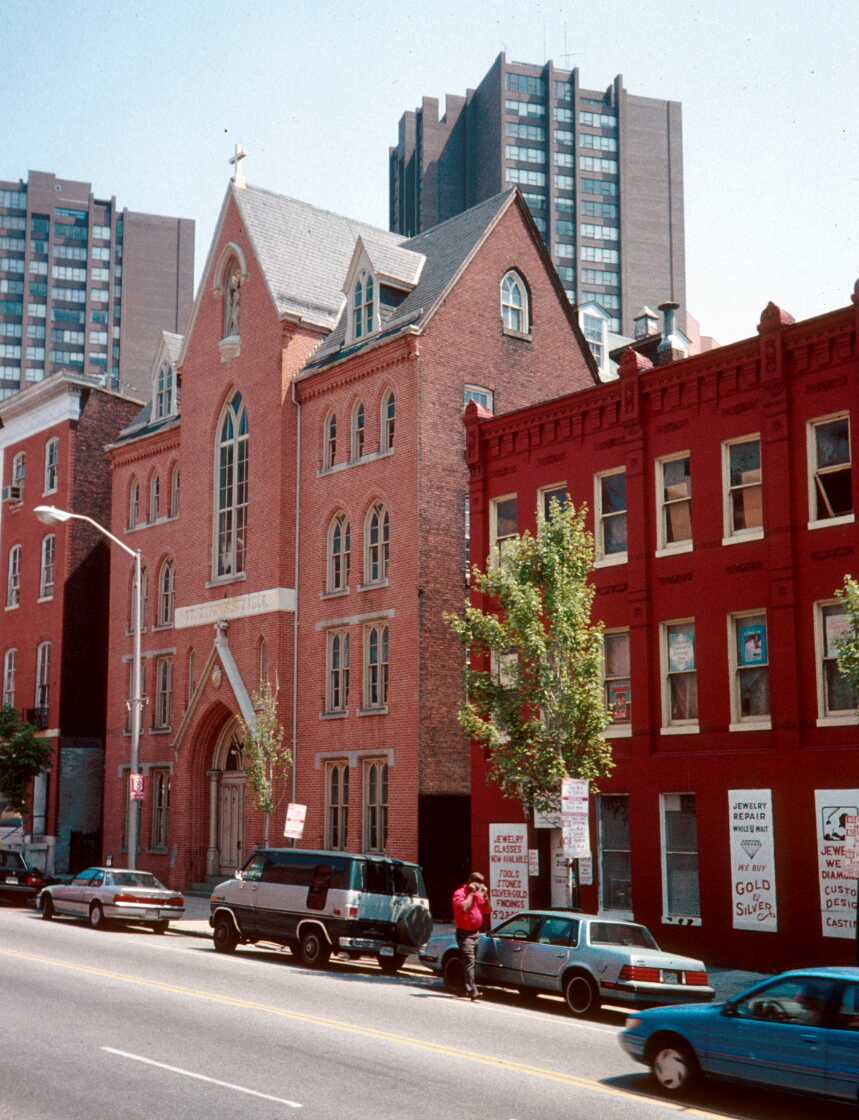
Photo credit:
Diane Shaw, 08/1991
|
St. Alphonsus' Church, Rectory, Convent, & Halle
Inventory No.:
B-128, B-22, B-4381
Date Listed:
5/25/1973
Location:
125-127 W. Saratoga Street , 114-120 W. Saratoga Street, 125 W. Saratoga Street, Baltimore, Baltimore City
Category:
Building
Period/Date of Construction:
1842 (church); 1873 (halle)
Architect/Builder:
Architect: Robert Cary Long, Jr.
|
|
Description:
This Gothic Revival building combines German and English perpendicular Gothic details. It is basically a large rectangular space with aisles and a nave of the same height. The star-shaped vaults although made of plaster, and the Perpendicular-style windows and tracery came from English sources. The walls and ceiling are stenciled with a strong gold access. The clustered iron columns are marbleized. There is a 4-stage bell tower topped with a spire over the main entranceway. The Halle (B-4381) is a 4 ½-story brick structure with a central pavilion topped by a gable. Both the 3-story convent and the 4-story rectory are brick.
|
Significance:
St. Alphonsus’ Church is an outstanding example of American Early Gothic Revival. Constructed between 1842 and 1844, it is one of the first Gothic buildings based on a careful study of medieval models which is most frequently characterized in the Anglo-American ecclesiological movement. St. Alphonsus’ was architect Robert Cary Long, Jr.’s first major commission. In its design, especially the interior, he benefited from his exposure to English Gothic Revival architects, notably A.W. Pugin. St. Alphonsus’ church, the institution, has played an important role in the history of Baltimore. The church was constructed by the Redemptionist Fathers, a German order of Roman Catholic priests who had come to Baltimore to minister to the rising number of German immigrants.
|
|
