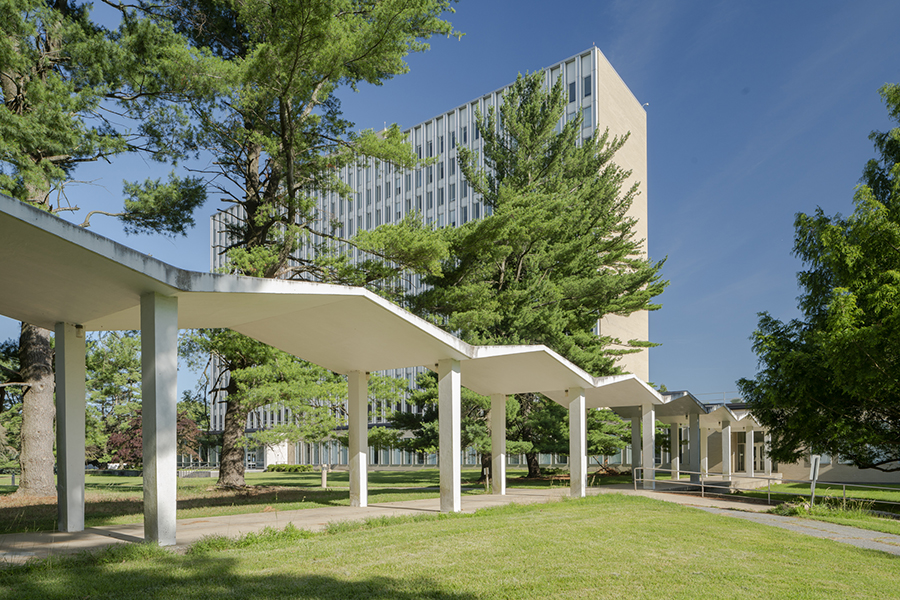
Photo credit:
Provided by Phillip W. Neuberg, 2022
|
NIST Historic District
Inventory No.:
M: 20-47
Other Name(s):
National Institute of Standards & Technology Historic District
Date Listed:
8/5/2021
Location:
100 Bureau Drive, Gaithersburg, Montgomery County
Category:
District
Period/Date of Construction:
1962-1969
Architect/Builder:
Voorhees Walker Smith Smith & Haines; HLW International
|
|
Description:
The National Institute of Standards and Technology (NIST) is a Federal research campus located in Montgomery County, Maryland, originally constructed in the early 1960s. The 579-acre Historic District is contiguous with the campus boundaries and is comprised of 74 buildings, structures, objects, and sites on a landscaped campus. Resources include monumental, multi-story buildings housing national laboratory and administrative spaces. Brick, marble and granite are the predominant construction materials along with aluminum and glass. The predominant building type is that of multi-story rectilinear research laboratories complex, pin-wheel type footprints; footprints are not uncommon. This carefully planned government funded scientific research campus, built specifically for the National Bureau of Standards (as it was then called) features a rigorous orthogonal layout featuring mature specimen and coniferous trees. Large expanses of mowed lawn and meadow define the campus. Circulation networks reinforce the geometry wit a grid-like street network and sidewalks. Original, historic and contemporary photographs attest to a remarkable level of architectural integrity. NIST is comprised of multiple buildings located on a formally landscaped campus organized by a grid network of internal roads. Large-scale, multi-story, monumental buildings separated by parking and grassy lawns define the campus. The internal road network consists of roads running in north/south and east/west directions. The publicly restricted road network creates large superblocks occupied by research buildings. An extensive landscape plan prepared by HLW International was developed in-house and implemented for the NIST campus in a phased approach following construction of the respective buildings. Large expanses of lawn buffer the campus from the main thoroughfares, and a large acreage of untouched wooded preserve is located at the western edge of campus. Specimen and ornamental trees are planted throughout the campus. The Newton apple tree, which is derived from cuttings of the tree purportedly belonging to Sir Isaac Newton in England, is planted next to the plaza north of Building 101. Building 101 also features an inner courtyard with flowering shrubs and trees, a specimen weeping European Beech tree, a rectangular shaped reflecting pool, benches, and a sundial that was relocated from NIST’s former campus in Washington, D.C. Building 101, the Administration Building, is a prominent contributing resource. Constructed in 1965 to house the agency’s executive offices, it also contained computer, applied mathematics, and statistical engineering laboratories. The building occupies a pinwheel-like footprint comprised of connecting masses of an eleven-story office tower, a two-story library, auditoria, a soaring cafeteria, and glazed concourses all organized about the internal, open-air courtyard.
|
Significance:
The NIST Historic District is historically significant for its association with events that have made important contributions to the broad patterns of history under the Science and Technology and Postwar Research Campus design themes. The NIST Historic District is also architecturally significant as a significant and distinguishable entity whose components may lack individual distinction. The collection of resources comprising the NIST Historic District achieves significance as an integrated campus associated with NIST history and the Science and Technology and Postwar Research Campus design themes. Resources in the historic district are related through function and design within the research campus. Buildings in the historic district were designed by an architecture and engineering firm with an established national practice in the design of research campuses. HLW International were acknowledged experts in designing research laboratories and were innovators in the field. They introduced such concepts as the modular laboratory. In addition, they worked collaboratively with scientists and administrators to ensure the buildings and the campus met their needs. Ample landscaping also was incorporated into the design of their campuses. A suburban settling and the use of the International Style are characteristics of their designs. The inclusion of such elements in research campuses became standard practice during the postwar years. The campus is representative of the firm’s body of work. The period of significance, 1962-1969, corresponds to the initial build-out of the 579-acre campus following the government’s amassing and purchase of the rural acreage of the late 1950s. The period of significance for the Historic District reflects therefore an association with scientific research events that took place following the initial construction. In addition to contributing to the NRHP, Building 101 individually is eligible for listing in the NRHP. Alterations to the buildings and landscape from the period of significance reflect this association and do not diminish integrity. The 24 contributing resources on the 579-acre campus all date from this period. The campus landscape plan, including the Newton Apple Tree, also is a contributing resource to the district. Contributing objects include the flagpole and a masonry test wall located on a remote part of the historic district.
|
|
District Resources
Resources not specifically itemized in a list within NR nomination form.
