Photo credit:
MHT Files, n.d.
|
Old Hamilton Library
Inventory No.:
B-5227
Other Name(s):
Enoch Pratt Free Library - Hamilton Branch
Date Listed:
9/25/2012
Location:
3006 Hamilton Avenue, Baltimore, Baltimore City
Category:
Building
Period/Date of Construction:
1920
Architect/Builder:
Architect: Theodore Wells Pietsch; Builder: R.B. Mason
|
|
Description:
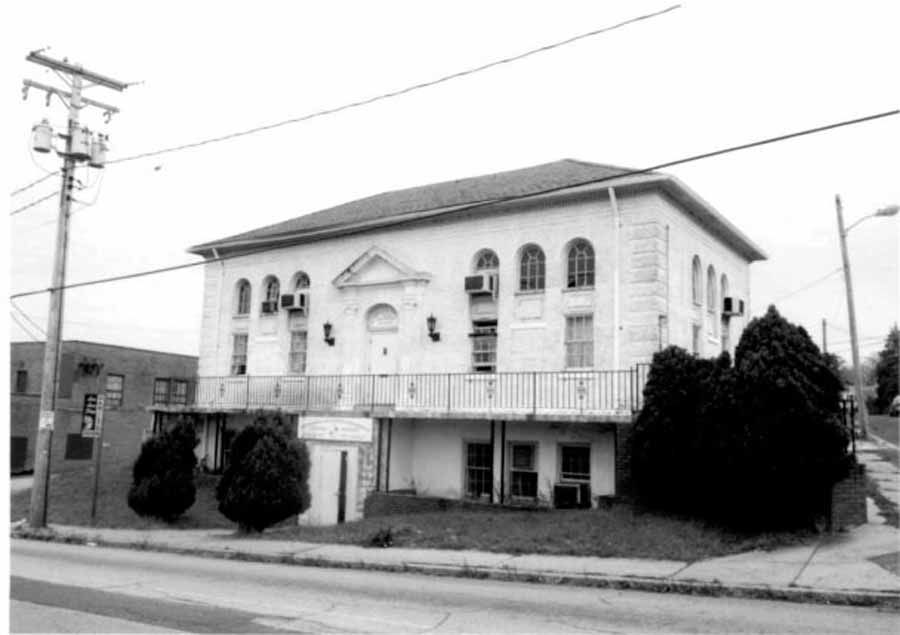
The Old Hamilton Library is a three-story building, rectangular in plan, seven bays wide by three bays deep, designed in a modest Beaux Arts style. The historic entrance is located on the south face of the building at the first floor above ground level flanked by two Ionic pilasters supporting an open triangular pediment. The basement entrance is a steel door located immediately below the historic entrance on the ground floor. The building has been modified since its original construction with the first floor divided into two stories, likely during the 1940s. Later use of the building divided the first level into two corridors of offices divided by wood-paneled walls. In addition, a paired set of stairs that flanked the historic entrance were removed and replaced by a concrete porch with a metal hand rail. Built in 1920, the building has a hip roof with an east-west ridge clad in slate tile. On the rear (north) side of the structure there is a two bay wide, one bay deep brick projection also sheltered by a hip roof. The walls are composed of stretcher bond brick, with decorative brick quoins at all four corners from the base of the first floor up to the roof line. On the ground floor the primary entrance is centered between six wooden sash 6/6 windows, with three windows on each side of a projecting brick bay in which a contemporary painted steel door is installed. A cement path leads from the sidewalk at the property line up to the ground floor entrance. A low brick wall in line with the front edge of the porch on the first level extends on both sides of the front entrance. On the first floor is the historic primary entrance with a door surround that extends up to the second floor of the structure. On either side of this central entrance are three tall round-arched window openings. As the building was originally designed and built as a one-story building with basement, the window openings on the first floor also extend up to the second floor, interrupted by wooden panels that are a later addition made when the first-floor level was divided into two. On the first-floor level, the center bay of each pair of three has been filled in with brick, while the right and left windows contain 6/6 sash windows. All three windows on the second floor contain 10-light round-arched windows. The arched portion of the window has three sections about a small arched element with a more standard 3/2 fixed element below. The central door is a contemporary steel door with a small glass window. The door is set in a semi-circular arched opening composed of header bricks with a sign for the building installed in the arched portion. Beyond this arched opening are two Ionic brick pilasters on either side of the door, extending up to the top of the arched opening. These pilasters support a modest Ionic entablature and an open triangular pediment, composed of stone and painted white like the south and east facades of the building. Above the third level is a single course of brick laid in a rowlock pattern quoins then a wood cornice painted light yellow that continues to follow the Ionic order of the door surround, with a simple design built up with a row of closely spaced dentils below an ogee below the projecting roofline. This cornice wraps around all four sides of the building. On the east façade, facing on Richard Avenue, are three tall window openings closely spaced and centered, in the same configuration as each of the sets of three windows on the front façade. The north façade features a substantial brick projection two bays wide by one bay deep with one 6/6 sash window on both the east and west sides, and two identical windows on the north side. The easternmost bay on the main block has a two-story window opening with a 6/6 sash window in the lower half and a fire door served by a metal fire escape inserted in the upper half of the opening. In the westernmost bay at the northwest corner of the building is a brick chimney. Much of the interior details, such as window trim and mouldings, are intact, along with the original wood windows, despite the modifications to the window openings.
|
Significance:
The Old Hamilton Library is a historic branch library building constructed in 1920 to serve the community of Hamilton in the then-rapidly developing corner of northeast Baltimore. The building remained in use as a library through 1959 when a new Hamilton Branch Library building opened on Harford Road. The Old Hamilton Library is historically significant for its association with the history of the development of the Harford Road corridor, and architecturally significant as the work of architect Theodore W. Pietsch and as an example of an early 20th century branch library in the Enoch Pratt Free Library system.
|
|
