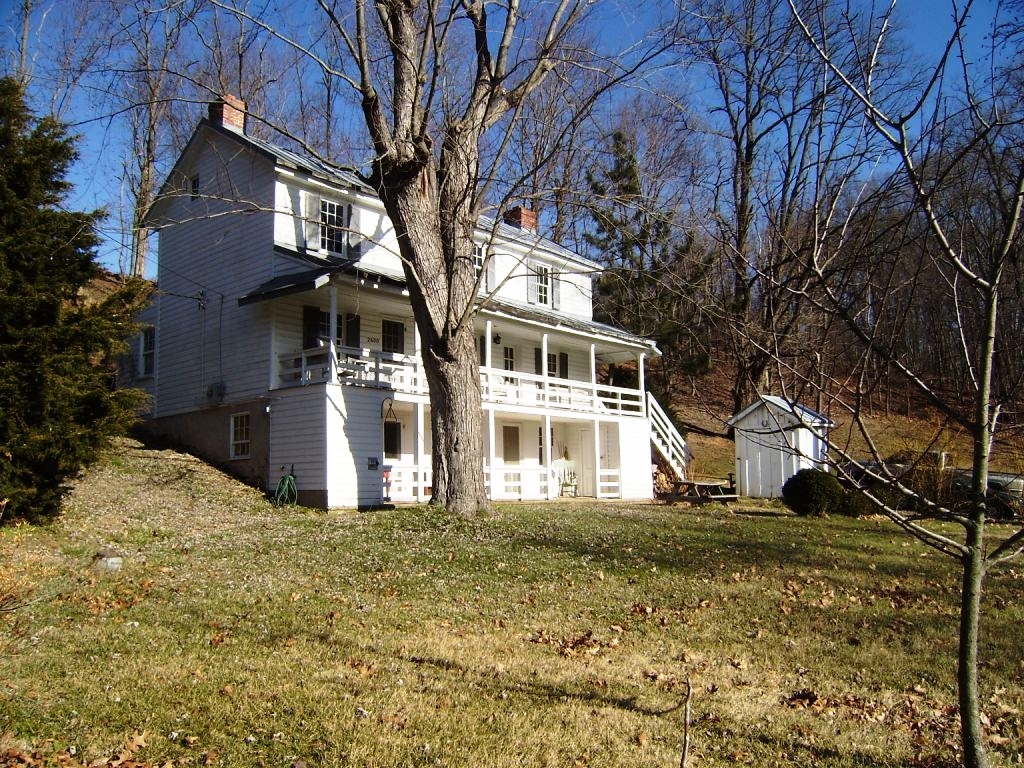
Photo credit:
P. Reed, 12/2009
|
Taylor-Manning-Leppo House
Inventory No.:
CARR-1711
Date Listed:
7/15/2009
Location:
2600 Patapsco Road, Finksburg, Carroll County
Category:
Building
Period/Date of Construction:
c. 1860, c. 1885
|
|
Description:
The Taylor-Manning-Leppo House is located on the north side of a winding country road, between Patapsco and Finksburg in Carroll County. The house was built in three sections. The original two-story log structure appears to date from the mid-19th century, with a third-story frame addition to it and a two-bay frame addition to its west end, both dating to the late 19th century. The house is one room deep with the original section following a hall-and-parlor plan. The 2 ½-story log and frame bank house rests on a stone foundation, exposed a full story in height across the front of the building. The foundation walls have been parged with stucco. The house is five bays in width, and one room deep. It is constructed into the sloping ground so that the second floor opens onto ground level at the rear of the building. Above the stone foundation, the east three bays are of log construction at the second level. The upper story is a frame addition. The west two bays are also a frame addition. Leppo family history indicates that Clarence Leppo was born in the third-floor room of the frame addition in 1890, suggesting that the additions predate this birth. The building is covered in German siding at the front and west walls and lapped weatherboarding elsewhere. A two-story porch extends across the front elevation, with enclosed ends creating ground floor external storage areas. A stairway leads to the upper level of the porch from its east end. A one-story porch extends across the rear elevation, serving the second level, which is at ground level at the rear of the building. A portion of the west side of the porch has been enclosed to create a bath and closet. Chimneys are located inside the gable ends and the roofing material is standing-seam metal which covers an earlier roof of wood shingles. Windows are generally 6/1 or 6/6 sash inside very narrow frames. Front windows at the second and third stories have louvered shutters. Other windows have no shutters. Some of the six-light sash have old, wavy glass. The 6/1 light sash probably are updates installed in the early 20th century. There is one 6/3 light sash in the west end cellar wall. The house has six exterior doors, four at the front elevation and two at the rear. The four doors at the front or south elevation are arranged with two at ground level and two at the second level, located in the second and fourth bays from the west end of the house. All of the doors have glass panes, either single or multiple, over lower wood panels. The west doors open into the frame addition and the east doors open into the original log section of the building. At the rear of the building, the doors are newer and multi-paned glass in wood. One door opens onto the rear porch from the original log section, and the other from the enclosed section of the west part of the rear porch. The porches are a major character-defining feature of the vernacular bank house type. They are shed-roofed and supported by wooden posts. The lower level posts at the front elevation are slightly larger than the ones above and those at the upper level are deeply chamfered, and thus slightly smaller. The balustrade consists of three horizontal railings which continue in the same pattern along the stairway leading from the upper deck down to the ground. The rear porch has chamfered posts and a surviving section of railing along the east end of the porch with top and bottom rails and vertical balusters. On the interior of the house, the ground floor level contains two rooms, a small room now serving as a kitchen at the west end and part of the late 19th century addition, and a larger room consisting of the older section of the house. A doorway was created in the latter 20th century between the original and added sections, to relieve the necessity of exiting the house to enter its other portion. In the east end of the ground floor is a large fireplace and a winder stair leading to the upper level. The walls are plastered except for the fireplace and the east wall in the stairway leading to the upper level, where the stones of the foundation have been exposed. The hewn joists for the floor aboveare exposed. The chimney wall includes the fireplace, staircase, and a small cupboard behind a tongue-and-groove batten door. The mantelpiece consists of a shelf supported by brackets and is a period reproduction which replaced a more stylish c. 1830s mantel that was removed from this location and installed in the room above. The second ground-level room, in the addition onto the west end of the original building, also features a winder stair, in its northwest corner, encased within a tongue-and-groove paneled enclosure. The second floor follows a similar plan. The walls are plastered except for the north wall which has had the plaster removed to expose the log construction. There is no ceiling. The hewn joists and the third-level flooring are exposed. The mantel moved from the ground floor has pilasters with a convex curved front surface and a heavily molded mantel shelf over a frieze. The mantel has tongue-and-groove doors to close off the firebox. There is no fireplace behind the mantel, and there is no evidence to suggest that there ever was a fireplace on the second floor of the building. In addition to the house, the property includes a late-19th century board-and-batten smokehouse, a mid-late 19th century bi-level stone root cellar constructed into a hillside, and a late-19th century frame garage/carriage shed.
|
Significance:
The Taylor-Manning-Leppo House is of local architectural significance as a well-preserved example of a mid-19th century log bank house with integrated late-19th century frame additions. It is a well-preserved representative example of a regionally identifiable building type that combines the Germanic-influenced “bank” construction form with the English hall-and-parlor plan. The house was initially constructed by c. 1860, and was essentially in its completed form by c. 1900.
|
|
