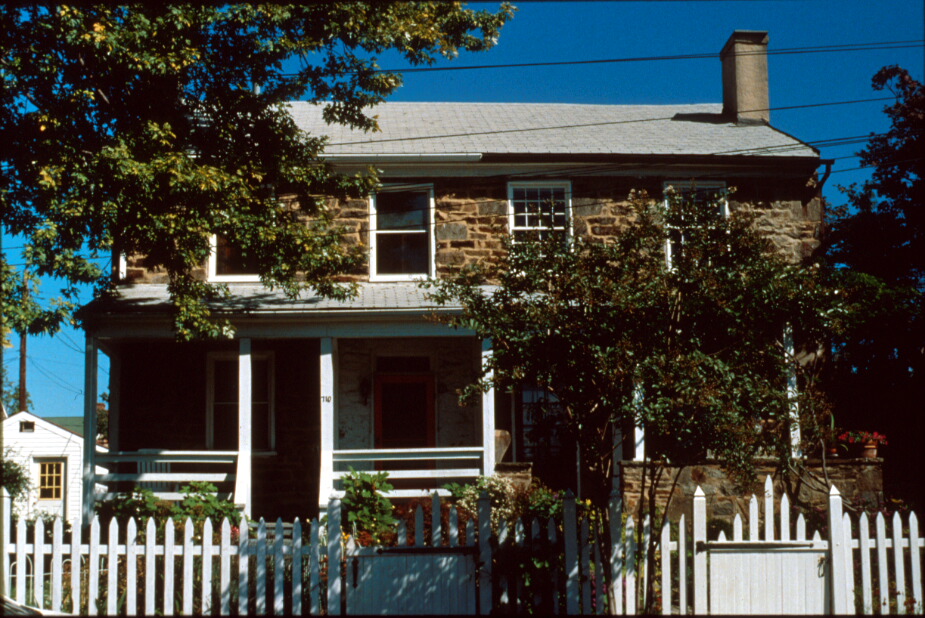
Photo credit:
Sherwin Mark, Summer, 2000
|
Stone Hill Historic District
Inventory No.:
B-1319
Date Listed:
12/26/2001
Location:
Baltimore, Baltimore City
Category:
District
Period/Date of Construction:
1845-1925
Boundary Description:
Bounded by Pacific St., Puritan St., Bay St., Field St., Worth St.
Resources:
23 (14 contributing, 0 non-contributing)
|
|
Description:
The Stone Hill Historic District, a complex of workers’ housing dating to the mid-19th century, consists of seven gridded blocks overlooking the Jones Falls. Associated with Mount Vernon Mills, the district is comprised of 21 granite duplexes, a granite Superintendent’s House, and a granite service building, now converted to a duplex. All of the buildings feature roughly coursed granite walls, gable roofs, front porches, and interior end chimneys with brick stacks. With the exception of the houses on the south side of Bay Street, all of the houses face south. Physical evidence found in the attic of 719 Field Street shows that the houses originally had wood shingle roofs. Sanborn Maps and surviving porches suggest that original hipped roof porches projected out from the two paired doors of each duplex. For the most part, the duplexes are two-story, four-bay, double-pile buildings on raised basements. They have a rectangular footprint with one-story kitchen wings extending out from the rear, which have gable roofs pierced by center chimneys. Original windows were 6/6 sash, with stone sills and brick lintels, although most now display 1/1 sash. Transoms top front doors.
|
Significance:
Constructed c. 1845-1847, the Stone Hill Historic District is one of the original mill villages along the Jones Falls developed to house textile mill workers. The Stone Hill Historic District is significant as evidence of changing settlement patterns in the Jones Falls valley beginning in the mid 19th century. The district is significant for its architecture because it exemplifies the distinctive characteristics of the Rhode Island-type of textile mill village, significant within the urban environment in Baltimore City, namely housing for families developed adjacent to manufacturing. This unusually cohesive district, unified by its corporate plan, repetition of massing and articulation, and distinctive use of stone construction, is an excellent example of workers’ housing in a textile mill village. The associated landscape created by private streets, lawns, gardens, picket fences, and front porches contributes to the singular character and rural village feeling of this unique historic district. Despite 25 to 75 years of private ownership, Stone Hill Historic District retains a high degree of integrity. Under mill ownership, from 1845 to 1925, changes to the buildings were minimal and consistent throughout the district. The sense of historic and architectural cohesiveness through its design, setting, materials, workmanship, and association is remarkably strong, contributing to the feeling of time and place. The mills and the pedestrian connections from the village to the manufacturing center are still intact. The period of significance for the district extends from c. 1845, the date of the first houses at Stone Hill, to 1925, the year Mount Vernon-Woodberry Mills began to the sell the houses to individual owners.
|
|
