Skip to Main Content
Maryland.gov Home
Medusa, Maryland's Cultural Resource Information System
Search
|
Map
|
Reports
|
Back
National Register of Historic Places
Log In
General Information
?
NR Name
: historic name
Alternate Name
: other name(s) associated with this property.
Print
NR Name:
Coldstream Homestead Montebello Historic District
NR Alternate Name:
Address Information
?
Address information in Medusa may differ from information submitted on the original or amended survey form
Address:
Town:
Baltimore
Zip Code:
Counties:
Baltimore City
USGS Quad(s):
Baltimore East
Listing Information
NPS Ref Number:
13000848
?
National Register reference number, provided by the National Park Service.
Confidential Location:
(not to be released)
?
Is the location of this resource confidential?
Category:
District
?
Category (Building, Structure, Object, Site, or District)
National Historic Landmark:
Date:
?
Is this listed as a National Historic Landmark? For more details, see www.nps.gov/nhl/
Date Listed:
10/23/2013
Delisted:
Date:
Date Revised:
Multiple Property Submission:
?
Is this a "multiple property submission? If so, what is the name of the multiple property submission?
Multiple Property Submission Name:
Construction Information
Architect/Builder:
Period/Date of Construction:
1908-1937
About This Resource
Capsule Summary Text:
?
Brief description of the resource and its significance, produced by MHT staff for its National Register website (apps.mht.maryland.gov/nr/). This is not necessarily the same as the text description in the actual National Register form, which can be viewed (if scanned) using the Open National Register Form link (below).
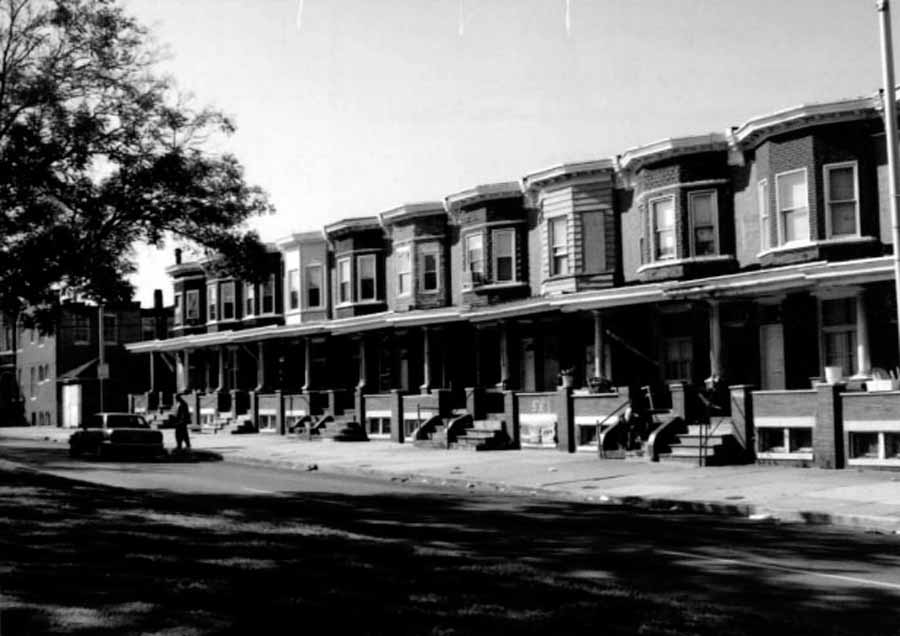
The Coldstream Homestead Montebello Historic District is a residential neighborhood located in northeastern Baltimore City, an area that was part of Baltimore County prior to its suburban development. The triangular-shaped community is set on a high plateau overlooking Clifton Park to its southeast and Lake Montebello to its northeast; Baltimore City College overlooks the neighborhood from the northwest side. The slope of the site enables houses on one side of the same street to be raised slightly above those on the opposite side of the street, often giving the impression of additional stories. The rectilinear-laid blocks are framed by narrow streets, each with on-street parking and tree-lined sidewalks of concrete. Traffic alternates in one direction on the east-west and north-south streets, with very narrow alleys running through the blocks. The multi-laned Hillen Road is at the approximate center of the neighborhood, traveling north-south to connect with East 33rd Street to the north and Harford Road to the south. The Coldstream Homestead Montebello Historic District was created and improved by several developers. Dr. Theodore Cooke constructed the eastern portion of the district, bound by Hillen Road to the west, Harford Road to the south and east, and East 33rd Street to the north. Frank Novak Realty Company constructed the western section of the district, bound by The Alameda and Kirk Avenue to the west, 29th Street to the south, Hillen Road to the east, and 33rd Street to the north. Rochester-Kirkness Realty Company, Joseph H. White Realty, and Broring Building Company developed the southwestern section of the neighborhood. Although the construction of the entire historic district spanned a 15-year period, the developers all built brick row houses, which through their architectural expressions, ornamentation, materials, setbacks, and massing present a cohesive neighborhood. The two types of row houses, reflecting housing needs before and after World War I, represent the porch-front rows of the Artistic period (1875-1915) and daylight rows of the Daylight period (1915-1955). The oldest of the row houses, dating from 1909 to 1920, are located in the southern part of the neighborhood from East 28th Street southward to the intersection of The Alameda and Harford Road, including those on the west side of The Alameda. Another grouping dating from this same period is located in the northeast corner of the neighborhood, marking the intersection of Harford Road with East 32nd Street. These are examples of the Artistic Period, with classically inspired architectural elements, full-width front porches, and oriel windows projecting from the second stories of the facades. Streets more centrally located in the neighborhood, reflecting the shorter yet wider buildings of the Daylight period, date from the early 1920s with a few row houses erected in the late 1920s. The row houses from the north side of East 32nd Street to East 33rd Street, west of Hillen Road, were constructed in the late 1920s through 1937. Contemporaneous corner and rows of commercial buildings are found along Hillen Road; corner commercial buildings once populated the neighborhood to a greater extent but most of the buildings have been razed or rehabilitated for another use. The small triangular lot created by Hillen Road, Harford Road, and Montebello Park has two freestanding commercial buildings designed and constructed by chain stores. These buildings replaced imposing freestanding single-family dwellings, which stood at 2910 to 2924 Harford Road, the latter now Montebello Park. The Coldstream Homestead Montebello Historic District is a cohesive residential neighborhood composed of fashionable brick row houses dating from the first half of the 20th century. Capitalizing on the electrification of the streetcar following the annexation of the area from Baltimore County, numerous developers, among them Frank Novak and Dr. Theodore Cooke, platted the area and oversaw construction of continuous rows of two-story single-family dwellings that epitomized suburban middle-class living with stylistic embellishments and materials, modern amenities, open front porches, and green lawns. The neighborhood illustrates the transition in row house design in Baltimore City from long and narrow structures of the Artistic period dressed in the Italianate style, to short and wide buildings of the Classical and Colonial Revival styles from the Daylight period. The realty companies exploited the neighborhood’s proximity to Clifton Park, Lake Montebello, and Baltimore City College, promoting the area’s rural characteristics and open spaces; all of which remain beneficial to the residents. Wide boulevards with landscaped medians, tree-lined streets, alleys with garages, stone-veneered churches reflecting the Late Gothic Revival style, and corner stores anchored within the uniform rows of houses add to the community’s strong sense of place. The Coldstream Homestead Montebello Historic District is historically significant for its role in the suburbanization of Northeast Baltimore and its association with middle-class Baltimoreans seeking the suburban ideal. The historic district is also architecturally significant as a cohesive residential neighborhood that illustrates the characteristics of early 20th-century row house design in form, materials, and design.
Boundary Description:
Comments:
Roughly bound by The Alameda, Kennedy Ave., and Kirk Ave, Harford R., East 32nd and East 33Sts.
Open National Register Form
Enlarge Photo
MHT Files, n.d.
View on MHT National Register Website
Related Records
?
Maryland Inventory of Historic Properties (MIHP), Archaeology (if authorized), Determination of Eligilibity (DOE), and/or MHT Preservation Easement records associated with this record.
Click on hyperlink to go to related record
B-5145
MIHP
Upper Coldstream Homestead Montebello Historic District
Easement
No Easement Records
B-5145
DOE
Upper Coldstream-Homestead-Montebello
Resource Information
?
Resource list associated with this form, if any. Entry of this information into the database is an ongoing project.
NR Form Resource List?:
Resource List Type:
Entered in Database?:
Print
A. That are associated with events that have made a significant contribution to the broad patterns of our history; or B. That are associated with the lives of significant persons in or past; or C. That embody the distinctive characteristics of a type, period, or method of construction, or that represent the work of a master, or that possess high artistic values, or that represent a significant and distinguishable entity whose components may lack individual distinction; or D. That have yielded or may be likely to yield, information important in history or prehistory. a. A religious property deriving primary significance from architectural or artistic distinction or historical importance; or b. A building or structure removed from its original location but which is primarily significant for architectural value, or which is the surviving structure most importantly associated with a historic person or event; or c. A birthplace or grave of a historical figure of outstanding importance if there is no appropriate site or building associated with his or her productive life; or d. A cemetery that derives its primary importance from graves of persons of transcendent importance, from age, from distinctive design features, or from association with historic events; or e. A reconstructed building when accurately executed in a suitable environment and presented in a dignified manner as part of a restoration master plan, and when no other building or structure with the same association has survived; or f. A property primarily commemorative in intent if design, age, tradition, or symbolic value has invested it with its own exceptional significance; or g. A property achieving significance within the past 50 years if it is of exceptional importance.