Skip to Main Content
Maryland.gov Home
Medusa, Maryland's Cultural Resource Information System
Search
|
Map
|
Reports
|
Back
National Register of Historic Places
Log In
General Information
?
NR Name
: historic name
Alternate Name
: other name(s) associated with this property.
Print
NR Name:
The Johns Hopkins Hospital Complex
NR Alternate Name:
Address Information
?
Address information in Medusa may differ from information submitted on the original or amended survey form
Address:
601 N. Broadway
Town:
Baltimore
Zip Code:
21287
Counties:
Baltimore City
USGS Quad(s):
Baltimore East
Listing Information
NPS Ref Number:
75002094
?
National Register reference number, provided by the National Park Service.
Confidential Location:
(not to be released)
?
Is the location of this resource confidential?
Category:
Building
?
Category (Building, Structure, Object, Site, or District)
National Historic Landmark:
Date:
?
Is this listed as a National Historic Landmark? For more details, see www.nps.gov/nhl/
Date Listed:
2/24/1975
Delisted:
Date:
Date Revised:
Multiple Property Submission:
?
Is this a "multiple property submission? If so, what is the name of the multiple property submission?
Multiple Property Submission Name:
Construction Information
Architect/Builder:
Architect: Cabot and Chandler
Period/Date of Construction:
1877-1889
About This Resource
Capsule Summary Text:
?
Brief description of the resource and its significance, produced by MHT staff for its National Register website (apps.mht.maryland.gov/nr/). This is not necessarily the same as the text description in the actual National Register form, which can be viewed (if scanned) using the Open National Register Form link (below).
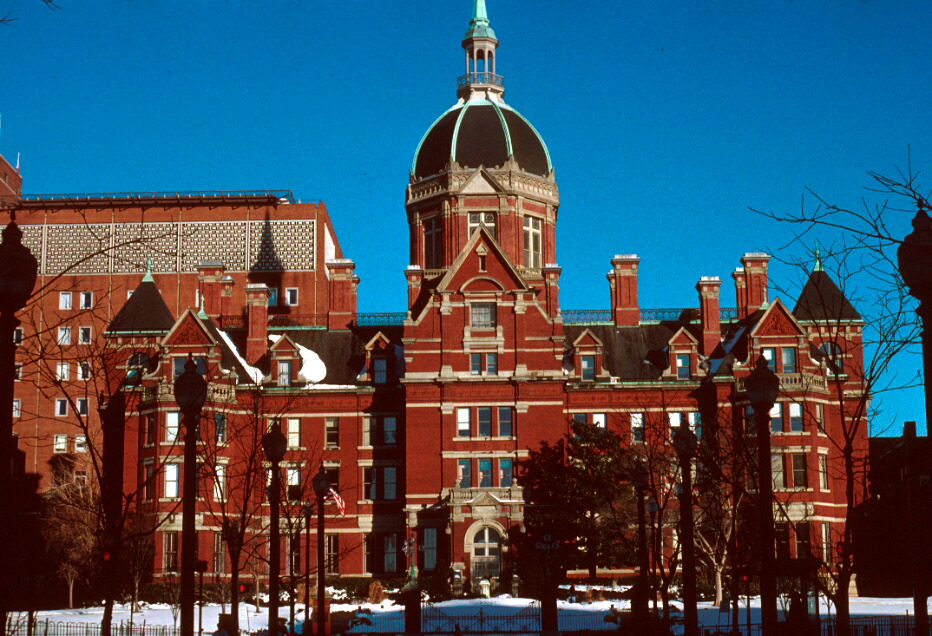
The three remaining original buildings of the Johns Hopkins Hospital are the Administration Building, the Marburg Buildings, and the Wilmer Building. Facing on Broadway, these three buildings harmonize with each other, and the major external ornamentation planned by the original designer is concentrated here. The designs were drawn by the firm of Cabot and Chandler of Boston in the Queen Anne style. The buildings were constructed of pressed brick, with ornamentation of dark blue, fine-grained, hard and durable Cheat River sandstone from West Virginia, and with ornamentation of molded terracotta matching the brick. The Administration Building in the center is the largest of the three, and the most important architecturally. The four-story building is crowned with a large dome with a central spire. The hospital’s main entrance is by porch on the west front, through a vestibule, which opens into a central, octagonal-shaped rotunda extending upward from the ground floor to the glass dome, which has been painted over to comply with World War II blackout regulations. A large double staircase leads to the three upper floors and to mahogany-trimmed balconies around the rotunda. The rotunda opens into the main hall, which runs north and south with a vestibule entrance at each end. Great attention was paid to architectural details of the interior, as shown by the marble floors, oak woodwork, heavily ornamented brass candelabra, decorative moldings and plaster work, numerous marble mantels, and carved brass hinges. The first floor contains offices, reception rooms, and the original board room. The upper floors, previously used partly as physicians’ residences, now contain only offices. Service facilities are located in the concrete and brick basement. The two pay wards flanking the Administration Building have small domes and similar façades, but few original interior furnishings. Each building contains a series of rooms on each side of a central corridor running north and south, with verandas on each end. At the junction of this corridor with an east and west corridor is an octagonal hall. The interiors of the buildings were finished in ash. Today the southern building houses clinics of the Wilmer Opthalmological Institute. Marburg, on the north, remains in use for private patients. Johns Hopkins (1795-1873) was a successful Baltimore merchant and banker who amassed a fortune of approximately seven million dollars. A bachelor, he decided to divide his fortune after his death between a hospital and a university. In 1867, bills were passed in the Maryland General Assembly to form two corporations, "The Johns Hopkins Hospital" and "The Johns Hopkins University;" their charter provided for close inter-locking arrangement between the two. Mr. Hopkins selected a site for the hospital in southeast Baltimore on Loudenschlager’s Hill, which had been occupied by the Maryland Hospital for the Insane since 1797. Hopkins gave the trustees a letter concerning the hospital and its duties, with detailed instructions about grading and preparing the land, building a hospital of the highest charter, and maintaining a close relationship with the medical school of the university. To complete the hospital’s tract of land, Mr. Hopkins agreed to purchase the portion on the western boundary of the lot owned by the Insane Asylum, to provide frontage on Broadway and form a total lot of 14 ½ acres; this portion had been occupied by several houses and a small cemetery, and was purchased by the Trustees after Mr. Hopkins’ death in 1873, at the age of 78. The trustees, with the advice of an authority on hospital construction, Dr. John S. Billings, employed first John R. Niernsee of the firm Niernsee and Neilson, and later Cabot and Chandler of Boston as architects. Construction began in June of 1877, but was not completed for 12 years. the hospital was formally opened on May 7, 1889. It gained early recognition through its famous doctors---Welch, Osler, Halsted, and Kelly. The Administration Building is still the focal point of the hospital, its dome often used as a symbol. To the north of this building is the ward originally used for male paying patients, which now houses all private medical and surgical patients. Named the Marburg Building, it is funded by the family of Charles L. Marburg (1842-1907), the head of a Baltimore tobacco firm. The female pay ward south of the Administration Building is now part of the Wilmer Opthalmological Institute, founded in 1925 by Dr. William Holland Wilmer (1863-1936), who was also the founder and one of the original trustees of Baltimore’s Roman Catholic Cathedral.
Boundary Description:
Comments:
Open National Register Form
Enlarge Photo
Michael O. Bourne, 02/1996
View on MHT National Register Website
Related Records
?
Maryland Inventory of Historic Properties (MIHP), Archaeology (if authorized), Determination of Eligilibity (DOE), and/or MHT Preservation Easement records associated with this record.
Click on hyperlink to go to related record
B-122
MIHP
Johns Hopkins Hospital Administration, Marburg & Wilmer Buildings
Easement
No Easement Records
DOE
No DOE Records
Resource Information
?
Resource list associated with this form, if any. Entry of this information into the database is an ongoing project.
NR Form Resource List?:
Resource List Type:
Entered in Database?:
Print
A. That are associated with events that have made a significant contribution to the broad patterns of our history; or B. That are associated with the lives of significant persons in or past; or C. That embody the distinctive characteristics of a type, period, or method of construction, or that represent the work of a master, or that possess high artistic values, or that represent a significant and distinguishable entity whose components may lack individual distinction; or D. That have yielded or may be likely to yield, information important in history or prehistory. a. A religious property deriving primary significance from architectural or artistic distinction or historical importance; or b. A building or structure removed from its original location but which is primarily significant for architectural value, or which is the surviving structure most importantly associated with a historic person or event; or c. A birthplace or grave of a historical figure of outstanding importance if there is no appropriate site or building associated with his or her productive life; or d. A cemetery that derives its primary importance from graves of persons of transcendent importance, from age, from distinctive design features, or from association with historic events; or e. A reconstructed building when accurately executed in a suitable environment and presented in a dignified manner as part of a restoration master plan, and when no other building or structure with the same association has survived; or f. A property primarily commemorative in intent if design, age, tradition, or symbolic value has invested it with its own exceptional significance; or g. A property achieving significance within the past 50 years if it is of exceptional importance.