Skip to Main Content
Maryland.gov Home
Medusa, Maryland's Cultural Resource Information System
Search
|
Map
|
Reports
|
Back
National Register of Historic Places
Log In
General Information
?
NR Name
: historic name
Alternate Name
: other name(s) associated with this property.
Print
NR Name:
Takoma Park Historic District
NR Alternate Name:
Address Information
?
Address information in Medusa may differ from information submitted on the original or amended survey form
Address:
Town:
Takoma Park
Zip Code:
Counties:
Montgomery
USGS Quad(s):
Washington West
Listing Information
NPS Ref Number:
76001008
?
National Register reference number, provided by the National Park Service.
Confidential Location:
(not to be released)
?
Is the location of this resource confidential?
Category:
District
?
Category (Building, Structure, Object, Site, or District)
National Historic Landmark:
Date:
?
Is this listed as a National Historic Landmark? For more details, see www.nps.gov/nhl/
Date Listed:
7/16/1976
Delisted:
Date:
Date Revised:
Multiple Property Submission:
?
Is this a "multiple property submission? If so, what is the name of the multiple property submission?
Multiple Property Submission Name:
Construction Information
Architect/Builder:
Period/Date of Construction:
1883-1920s
About This Resource
Capsule Summary Text:
?
Brief description of the resource and its significance, produced by MHT staff for its National Register website (apps.mht.maryland.gov/nr/). This is not necessarily the same as the text description in the actual National Register form, which can be viewed (if scanned) using the Open National Register Form link (below).
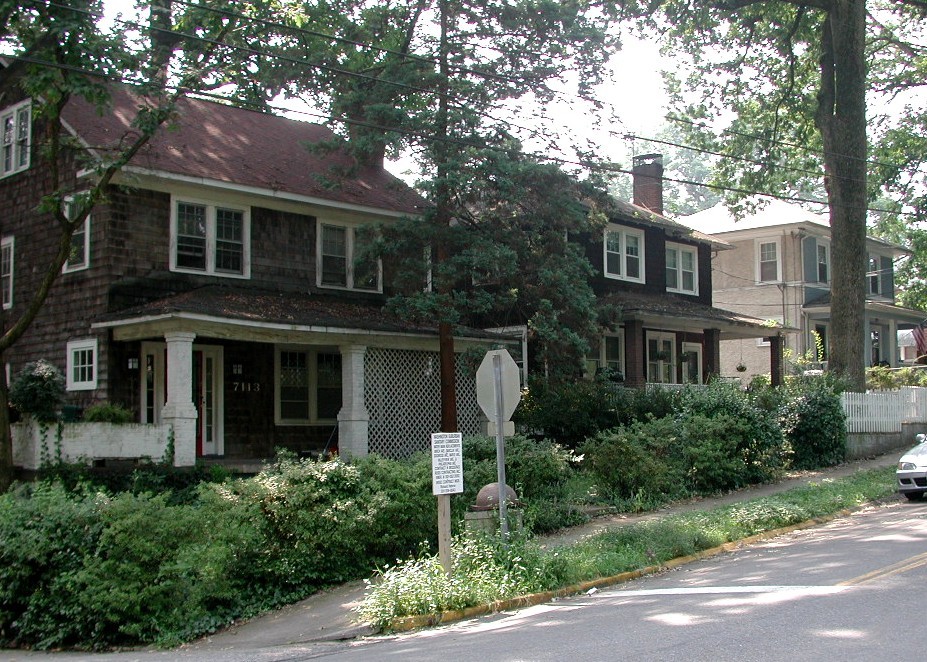
Takoma Park Historic District was platted in 1883 by developer Benjamin Franklin Gilbert, and promoted for its natural environment and healthy setting. Originally an early railroad suburb, the opening of streetcar lines led to the expansion of the district in the early 20th century. Takoma Park houses built between 1883 and 1900 were fanciful, turreted, multi-gabled affairs of Queen Anne, Stick Style, and Shingle Style influence. These first houses were substantial residences with spacious settings. Lots were deep and houses were set at least 40 feet from the street. By 1886, Takoma Park had a post office and a new railroad station, and the town's population had quadrupled by 1893. The start of streetcar service along Carroll Avenue in 1893 made the adjacent areas more attractive for residential development, leading to new subdivisions. The inexpensive electric streetcar, the availability of low-cost house plans and kit houses in combination with smaller lot sizes made homeownership in Takoma Park possible for individuals with more modest income levels than during the previous period. By 1922, the population soared to 4,144, making Takoma Park the tenth largest incorporated town in Maryland. The houses built in Takoma Park during the period between 1900 and 1930 reveal changing American tastes in house design from the elaborate ornamentation of the late-19th century dwellings to more practical, simplified designs. Many of these early-20th century houses reflect the aesthetics of the Arts and Crafts Movement, which emphasized the inherent nature of the building materials and structural elements for ornamentation. Similarly, they reflect a social trend towards a more informal, unpretentious style of living. Scores of Bungalows, and Craftsman-style houses and catalog-order houses were built in this era. After the turn of the 20th century, schools and libraries began to blossom, and several such community service buildings remain, although with new uses. Takoma Park's commercial districts retain their original early-20th century character. Most of these buildings are 1-2 story brick structures with simple ornamentation, although a few display characteristics of such styles as Art Deco and Tudor Revival. The Takoma Park Historic District, divided into two sections, is a residential community founded in the early 1880s which retains the original relationship of suburban structures to each other and to the town as a whole. The intentions of the town's founder, B.F. Gilbert, to create a sylvan suburb within easy reach of Washington, D.C., have continued to the present day. The district is in two parts in order to isolate those areas of Takoma Park which best represent the historic character of the town. The individual structures possess a sense of cohesiveness of design expressed in the rhythm established by the large lot sizes in relation to the buildings on them; in the vernacular expression of the popular architectural styles of the late 19th through early 20th centuries, including Queen Anne, Georgian Revival, and bungalow styles, in the predominance of wood as the principal building material in both shingle and clapboard exteriors, in the historical associations of Takoma Park with the American suburban movement as well as with the Seventh Day Adventist Church who chose Takoma Park for its headquarters in 1903, and, finally, the integrity of the district derives from an intangible impact of time and place on visitors.
Boundary Description:
Comments:
Open National Register Form
Enlarge Photo
Jennifer Falkinburg, 08/23/2003
View on MHT National Register Website
Related Records
?
Maryland Inventory of Historic Properties (MIHP), Archaeology (if authorized), Determination of Eligilibity (DOE), and/or MHT Preservation Easement records associated with this record.
Click on hyperlink to go to related record
M: 37-3
MIHP
Takoma Park Historic District
PG:65-12
MIHP
Takoma Park Historic District
Easement
No Easement Records
M: 37-3
DOE
Takoma Park Historic District - West Side
Resource Information
?
Resource list associated with this form, if any. Entry of this information into the database is an ongoing project.
NR Form Resource List?:
Resource List Type:
Entered in Database?:
Print
A. That are associated with events that have made a significant contribution to the broad patterns of our history; or B. That are associated with the lives of significant persons in or past; or C. That embody the distinctive characteristics of a type, period, or method of construction, or that represent the work of a master, or that possess high artistic values, or that represent a significant and distinguishable entity whose components may lack individual distinction; or D. That have yielded or may be likely to yield, information important in history or prehistory. a. A religious property deriving primary significance from architectural or artistic distinction or historical importance; or b. A building or structure removed from its original location but which is primarily significant for architectural value, or which is the surviving structure most importantly associated with a historic person or event; or c. A birthplace or grave of a historical figure of outstanding importance if there is no appropriate site or building associated with his or her productive life; or d. A cemetery that derives its primary importance from graves of persons of transcendent importance, from age, from distinctive design features, or from association with historic events; or e. A reconstructed building when accurately executed in a suitable environment and presented in a dignified manner as part of a restoration master plan, and when no other building or structure with the same association has survived; or f. A property primarily commemorative in intent if design, age, tradition, or symbolic value has invested it with its own exceptional significance; or g. A property achieving significance within the past 50 years if it is of exceptional importance.