Skip to Main Content
Maryland.gov Home
Medusa, Maryland's Cultural Resource Information System
Search
|
Map
|
Reports
|
Back
National Register of Historic Places
Log In
General Information
?
NR Name
: historic name
Alternate Name
: other name(s) associated with this property.
Print
NR Name:
Savage Mill Historic District
NR Alternate Name:
Address Information
?
Address information in Medusa may differ from information submitted on the original or amended survey form
Address:
Town:
Savage
Zip Code:
Counties:
Howard
USGS Quad(s):
Savage
Listing Information
NPS Ref Number:
75000905
?
National Register reference number, provided by the National Park Service.
Confidential Location:
(not to be released)
?
Is the location of this resource confidential?
Category:
District
?
Category (Building, Structure, Object, Site, or District)
National Historic Landmark:
Date:
?
Is this listed as a National Historic Landmark? For more details, see www.nps.gov/nhl/
Date Listed:
2/20/1975
Delisted:
Date:
Date Revised:
Multiple Property Submission:
?
Is this a "multiple property submission? If so, what is the name of the multiple property submission?
Multiple Property Submission Name:
Construction Information
Architect/Builder:
Period/Date of Construction:
1816-1948
About This Resource
Capsule Summary Text:
?
Brief description of the resource and its significance, produced by MHT staff for its National Register website (apps.mht.maryland.gov/nr/). This is not necessarily the same as the text description in the actual National Register form, which can be viewed (if scanned) using the Open National Register Form link (below).
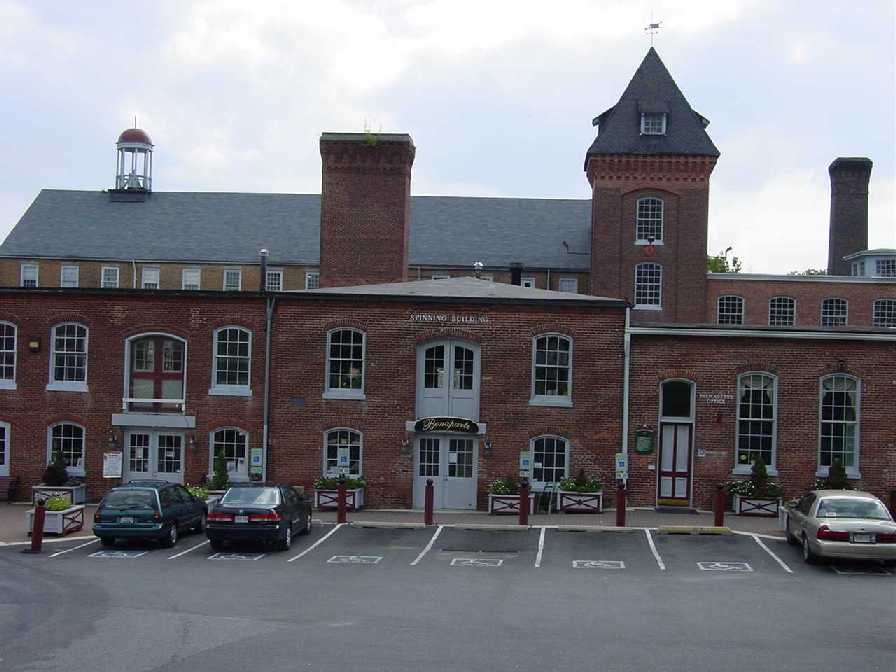
The Savage Mill Historic District comprises the industrial complex of Savage Mill and the village of workers' housing to the north of the complex. The mill complex consists of eight principal buildings and several others of more minor associations. The oldest structure is the stone carding and spinning building, probably built between 1816 and 1823. It originally housed all the activities of the industry until the mill was expanded before 1881. Four stories tall, 16 bays long, and 2 bays deep, the building has 12/12 sash windows. A brick tower with Romanesque overtones was added before 1881, with a corbeled brick cornice and pyramidal roof with shed dormers. Other buildings include the weaving shed, preparation area, paymaster's office, and several early-20th century warehouses and power plants. The mill has been converted into artists' studios, antique shops, and a restaurant. The mill village consists primarily of brick workers' houses built at various times throughout the 19th century. The earliest of these appear to be those on the north side of Washington Street and the north and south sides of Baltimore Street, between Commerce and Foundry Streets. With the exception of one building, which was demolished in the 20th century and replaced with a modern rancher, all of these are recorded in the Hopkins' Atlas of 1878. All of the buildings in Savage, most especially those appearing to have been built prior to 1850, are of a basic Federal style, built of common bond brick, uniform in overall structure appearance and detail. All contain a minimum of two dwelling units, the largest four. Most windows have 6/6 lights with flat arches. At the south end of Commercial Street, on the southeast corner of its intersection with Foundry Street, is a handsome rectangular stone building with a jerkinhead roof, built about 1926-30 as a community center. It is a large one-story structure of rough uncoursed fieldstone, four bays in length and three bays wide at the gable facade. Savage Mill is an important early-19th century industrial landmark. It is one of the oldest known surviving textile mills in Maryland, providing physical evidence that New England did not monopolize that industry in the last century. In fact, cotton production in Maryland began as early as 1808. The extensive additions to the original stone mill illustrate the growth of one participant in the industry which in the late 19th century counted on Maryland for the majority of the nation's cotton duck. The site of Savage Mill on the rapids of the Little Patuxent River had been used for mill operations since the mid 18th century. In the early 1820s the Savage Manufacturing Company purchased the site, erected a factory, and installed machinery. John Savage of Philadelphia funded the company which still bears his name. The complex then included a mill, 500 acres of land, a warehouse, a flour mill, and a saw mill. When the company began producing cotton duck, 22 other Maryland factories were engaged in the same activity. By 1825 the mill employed 200 people including women and children, and 120 power looms. The complex included several additions: a grist mill, an iron foundry, and a machine shop. The company was sold to William H. Baldwin, Jr. in 1847, who owned the firm Woodward, Baldwin and Company, a well established Baltimore dry goods marketing company. Under Baldwin's management the enterprise at Savage prospered. The iron foundry resumed operations concentrating on the production of cotton machinery. The majority of the workers houses in the village date from this period, as did the dry goods store and grocery. In the early 20th century, the company became Baldwin, Leslie and Company, and the mill was expanded in anticipation of wartime needs. A decade later the Baldwin family erected a stone community hall for the town and constructed a large group of tenant houses. By 1941 the company employed 325 people. Under wartime production the mill produced 400,000 pounds of cotton duck a month. In 1948 the mill closed, and in the 1950s it spent a brief period being used to manufacture Christmas ornaments before closing permanently. The mill has now been converted for use as a series of artists studios, shops, antiques stores, and a restaurant.
Boundary Description:
Comments:
Open National Register Form
Enlarge Photo
Jennifer Falkinburg, 08/22/2003
View on MHT National Register Website
Related Records
?
Maryland Inventory of Historic Properties (MIHP), Archaeology (if authorized), Determination of Eligilibity (DOE), and/or MHT Preservation Easement records associated with this record.
Click on hyperlink to go to related record
HO-42
MIHP
Savage Mill Historic District
Easement
No Easement Records
DOE
No DOE Records
Resource Information
?
Resource list associated with this form, if any. Entry of this information into the database is an ongoing project.
NR Form Resource List?:
Resource List Type:
Entered in Database?:
Print
A. That are associated with events that have made a significant contribution to the broad patterns of our history; or B. That are associated with the lives of significant persons in or past; or C. That embody the distinctive characteristics of a type, period, or method of construction, or that represent the work of a master, or that possess high artistic values, or that represent a significant and distinguishable entity whose components may lack individual distinction; or D. That have yielded or may be likely to yield, information important in history or prehistory. a. A religious property deriving primary significance from architectural or artistic distinction or historical importance; or b. A building or structure removed from its original location but which is primarily significant for architectural value, or which is the surviving structure most importantly associated with a historic person or event; or c. A birthplace or grave of a historical figure of outstanding importance if there is no appropriate site or building associated with his or her productive life; or d. A cemetery that derives its primary importance from graves of persons of transcendent importance, from age, from distinctive design features, or from association with historic events; or e. A reconstructed building when accurately executed in a suitable environment and presented in a dignified manner as part of a restoration master plan, and when no other building or structure with the same association has survived; or f. A property primarily commemorative in intent if design, age, tradition, or symbolic value has invested it with its own exceptional significance; or g. A property achieving significance within the past 50 years if it is of exceptional importance.