Skip to Main Content
Maryland.gov Home
Medusa, Maryland's Cultural Resource Information System
Search
|
Map
|
Reports
|
Back
National Register of Historic Places
Log In
General Information
?
NR Name
: historic name
Alternate Name
: other name(s) associated with this property.
Print
NR Name:
Hessian Barracks
NR Alternate Name:
Address Information
?
Address information in Medusa may differ from information submitted on the original or amended survey form
Address:
242 S. Market Street (MD 355)
Town:
Frederick
Zip Code:
Counties:
Frederick
USGS Quad(s):
Frederick
Listing Information
NPS Ref Number:
71000373
?
National Register reference number, provided by the National Park Service.
Confidential Location:
(not to be released)
?
Is the location of this resource confidential?
Category:
Building
?
Category (Building, Structure, Object, Site, or District)
National Historic Landmark:
Date:
?
Is this listed as a National Historic Landmark? For more details, see www.nps.gov/nhl/
Date Listed:
1/25/1971
Delisted:
Date:
Date Revised:
Multiple Property Submission:
?
Is this a "multiple property submission? If so, what is the name of the multiple property submission?
Multiple Property Submission Name:
Construction Information
Architect/Builder:
Period/Date of Construction:
c. 1780
About This Resource
Capsule Summary Text:
?
Brief description of the resource and its significance, produced by MHT staff for its National Register website (apps.mht.maryland.gov/nr/). This is not necessarily the same as the text description in the actual National Register form, which can be viewed (if scanned) using the Open National Register Form link (below).
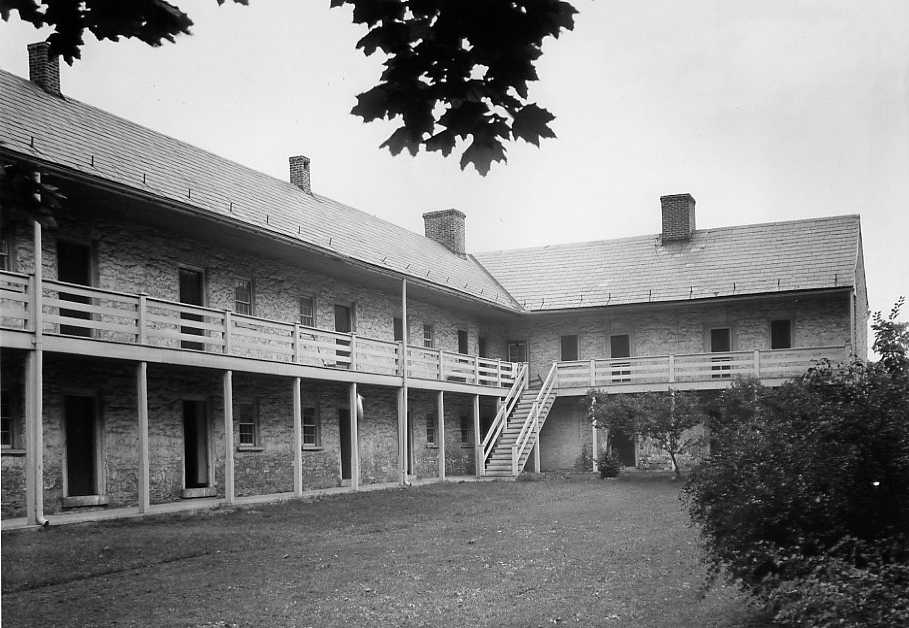
The Hessian Barracks is an L-shaped two-story stone structure with gallery porches. A gable roof covers the structure, including the porches. This structure remains of two original L-shaped buildings which, between the two, enclosed a yard. The reputedly older building was demolished c. 1870 to supply materials to erect the Maryland School for the Deaf brick building which overshadows the remaining "barracks." The longer (north) exterior wall of the existing building and the short (east) exterior wall (the short, base, of the "L") are pierced by occasional small, double-hung sash windows. The interior walls, along the galleries, are regularly pierced on both floors by sturdy doors with six deeply beveled panels, and with double-hung windows that show some early glass panes. Pegged frames with heavy cyma reversa mold surround each window opening; most of the wood trim throughout the structure appears to be early. The doorways on each floor open into a series of plain, rectangular rooms. At neither level is there an interior passageway. The inter-room door of each room leads directly into the next in line. The interior common wall between each two rooms are fitted with fireplaces, back-to-back; the stack of each couple rises to just above the ridge pole appearing as a series of wide, squat chimneys. There are two interior plain, narrow, wooden staircases between the two story levels. Two exterior, plain, wooden staircases rise from the lower to the upper galleries. Two historians of Frederick, Maryland, Lucy Leigh Bowie (in 1939) and J. Thomas Scharf (in 1882) maintained that the Hessian Barracks were built during the French and Indian War (1754-1763). The first principal (William D. Cooke) of the Maryland School for the Deaf located on the barracks grounds, in his history of the institution, was unable to date the barracks exactly. He did state: "It is known, however, that they were built during the reign of George II, and that they were occupied by General Braddock and his troops on their route to Fort Dusquene." The State of Maryland contracted to build "a" barracks in Frederick in the summer of 1777, but this structure was not completed in 1781. A letter from a British officer, a prisoner of war, to Governor Thomas Sim Lee, dated January 30, 1781, reveals the condition of the then-incomplete barracks, being at that time used as a prison. French prisoners of war captured during the undeclared sea war with France (1799) and British soldiers taken prisoner in the War of 1812 occupied the barracks. In the 19th century the Barracks served several state and community needs, including a state armory and a silk worm production site, and the barracks yard served as the Agricultural Fairgrounds from 1853 to 1860. After the Battle of Antietam in 1862, the Barracks building served as a hospital for the wounded from both North and South. Every available space in Frederick from hotels to high schools, including the Barracks, was taken up for the estimated 4,000 wounded hospitalized there. The State of Maryland chose the Barracks grounds for the location of a new school, the Maryland Institution for the Deaf and Dumb (1867). Before the construction of the first building in 1871, the school met in the barracks. The Industrial Department of the Maryland Institution for the Deaf and Dumb continued to use the barracks for a few years after the construction of the 1871 school building. The school's Board of Directors authorized demolition of the western of the two original barracks buildings.
Boundary Description:
Comments:
Open National Register Form
Enlarge Photo
Collections of the Library of Congress, Undated Photo
View on MHT National Register Website
Related Records
?
Maryland Inventory of Historic Properties (MIHP), Archaeology (if authorized), Determination of Eligilibity (DOE), and/or MHT Preservation Easement records associated with this record.
Click on hyperlink to go to related record
FHD-243
MIHP
Hessian Barracks (Frederick Barracks)
Easement
No Easement Records
DOE
No DOE Records
Resource Information
?
Resource list associated with this form, if any. Entry of this information into the database is an ongoing project.
NR Form Resource List?:
Resource List Type:
Entered in Database?:
Print
A. That are associated with events that have made a significant contribution to the broad patterns of our history; or B. That are associated with the lives of significant persons in or past; or C. That embody the distinctive characteristics of a type, period, or method of construction, or that represent the work of a master, or that possess high artistic values, or that represent a significant and distinguishable entity whose components may lack individual distinction; or D. That have yielded or may be likely to yield, information important in history or prehistory. a. A religious property deriving primary significance from architectural or artistic distinction or historical importance; or b. A building or structure removed from its original location but which is primarily significant for architectural value, or which is the surviving structure most importantly associated with a historic person or event; or c. A birthplace or grave of a historical figure of outstanding importance if there is no appropriate site or building associated with his or her productive life; or d. A cemetery that derives its primary importance from graves of persons of transcendent importance, from age, from distinctive design features, or from association with historic events; or e. A reconstructed building when accurately executed in a suitable environment and presented in a dignified manner as part of a restoration master plan, and when no other building or structure with the same association has survived; or f. A property primarily commemorative in intent if design, age, tradition, or symbolic value has invested it with its own exceptional significance; or g. A property achieving significance within the past 50 years if it is of exceptional importance.