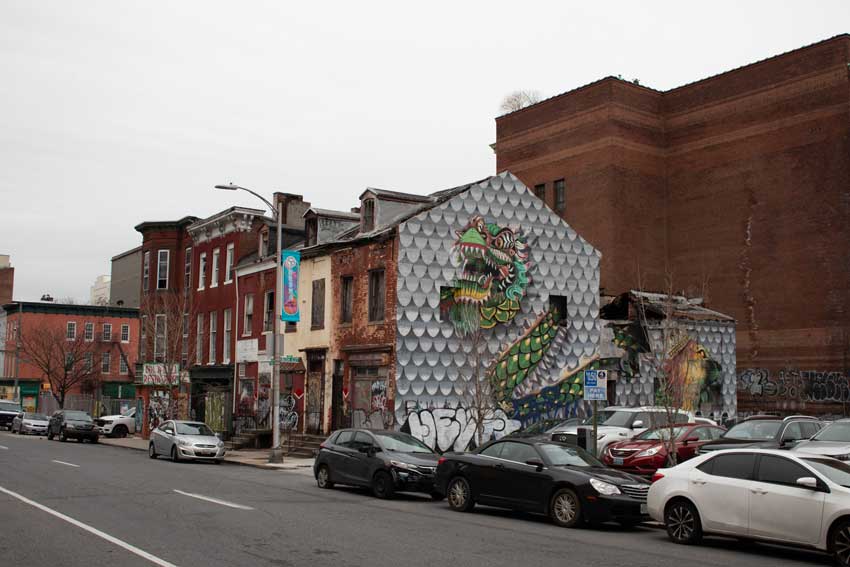
Photo credit:
Nicole A. Diehlmann (RK&K, LLP), 02/22/2023
|
Chinatown Historic District
Inventory No.:
B-5343
Date Listed:
3/4/2024
Location:
Roughly bounded by Wilson Alley to the north, Park Avenue and Montague Street to the east, 304 Park Avenue to the south, and 223 W. Mulberry Street and Tyson Street to the west, Baltimore, Baltimore City
Category:
District
Period/Date of Construction:
c. 1920-1977
Boundary Description:
The Chinatown Historic District boundaries include the north side of Inloes Alley and the parcel boundaries of 400-414 Park Avenue defining the northern boundary; the east side of Park Avenue defining the eastern boundary; the southern parcel boundary of 317 Park Avenue and the southern parcel boundary of 304 Park Avenue defining the southern boundary, and the western boundary being defined by the western (rear) boundaries of the parcels in the 300 block of Park Avenue, the south and western parcel boundary of 211 W. Mulberry, the parcel boundaries for 219 and 223 W. Mulberry Street, and the west boundary of 400-404 Park Avenue.
Related Multiple Property Record:
Asian American Communities in Maryland
|
|
Description:
The Chinatown Historic District is located in downtown Baltimore and is within the Market Center Historic District (NR-1230). The district is roughly bounded by Wilson Alley to the north, Park Avenue and Montague Street to the east, 304 Park Avenue to the south, and 223 West Mulberry Street and Tyson Street to the west. There are 25 buildings within the Chinatown Historic District boundary, of which 24 are contributing. Overall, the neighborhood is commercial and urban in character, with no open spaces such as parks or landscaped areas; however, demolition has resulted in some vacant lots, including the lot at 400 Park Avenue that formerly housed some Chinese businesses. Buildings are set in a gridded pattern and are primarily late-nineteenth-century Italianate rowhouses, intermixed with some early nineteenth- and early twentieth-century buildings. Standing between two-and-a-half to four stories tall, with flat or side-gable roofs, the buildings in the district feature commercial storefronts on the first stories. Many retain historic signage, some in Chinese lettering, reflecting the district’s role as an ethnic Chinese and Chinese American enclave between circa 1920 and the late twentieth century.
|
Significance:
The Chinatown Historic District is nominated under the Asian American Communities in Maryland Multiple Property Submission; it represents the largest extant, contiguous group of properties associated with Baltimore’s Chinese and Chinese American population in the twentieth century. Between circa 1920 through 1977, the 300 and 400 blocks of Park Avenue and the 200 block of W. Mulberry Street contained numerous businesses and organizations established by and/or for Chinese and Chinese Americans that contributed to the establishment of a distinct enclave in Baltimore. The area was not only a hub of commercial activity, but hosted social and cultural events as well, including annual Lunar New Year celebrations. The extant buildings illustrate the second iteration of Baltimore’s Chinatown, after displacement in the 1920s forced businesses and residents of the original enclave north on Park Avenue. Chinatown continued to maintain its role as a Chinese cultural center into the late 1970s, when several landmark restaurants were still operating in the neighborhood and community leaders like Calvin Chin and the Chinese Consolidated Benevolent Association were attempting to revitalize the area and celebrate its rich cultural history. This is the only district of its type in Maryland.
|
|
District Resources
Resources not specifically itemized in a list within NR nomination form.
