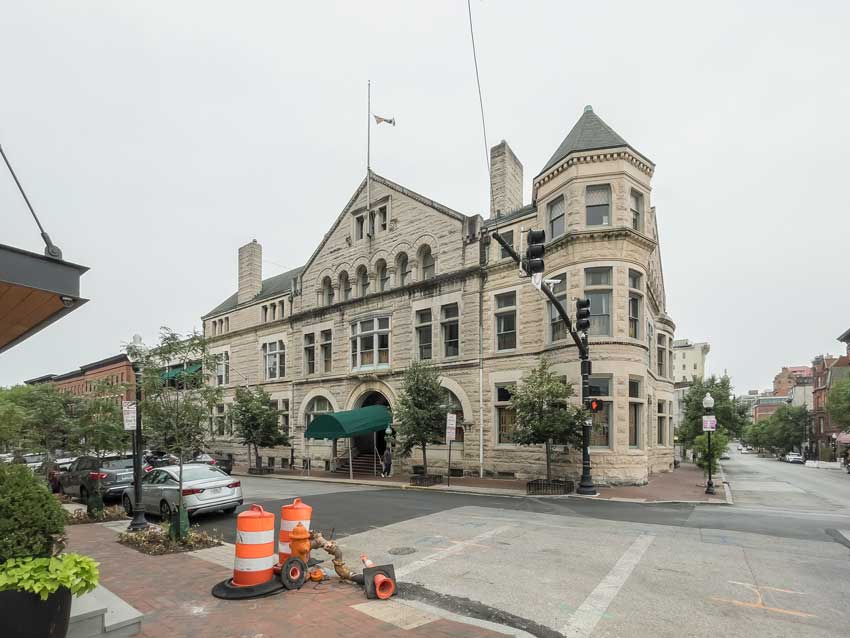
Photo credit:
John Eichelberger, Doug Miller, 06/2023
|
The Maryland Club
Inventory No.:
B-119
Date Listed:
1/29/2024
Location:
1 E. Eager Street, Baltimore, Baltimore City
Category:
Building
Period/Date of Construction:
1891-1973
Architect/Builder:
Josias Pennington
Boundary Description:
The Maryland Club at 1 East Eager Street, Baltimore, Maryland: Beginning for the same a point formed by the intersection of the Easterly Right of Way line of North Charles Street, 66 feet wide, and the Southerly Right of Way line of East Eager Street, 66 feet wide; thence leaving the point of beginning with all bearings being referenced to a Drawing prepared by the City of Baltimore having a File Reference of 348-A-38. Tax I.D. No. 11-12-0521-028.
|
|
Description:
The Maryland Club is a private social club founded in Baltimore in 1857. Its current headquarters building in the Mount Vernon neighborhood was constructed in 1891 in the Richardsonian Romanesque style, and was designed by Josias Pennington, a native Baltimorean best known for his railway buildings and for his alterations and additions to the Maryland State House. Pennington completed the Maryland Club’s first addition, soon after its construction, in 1903. The building’s architectural quality is reflected in details such as its local marble facing, corner tower, arched entry, carved Romanesque details, varied fenestration, projecting gabled pavilions, and large chimneys. Its interior largely retains its original finishes, especially Beaux-Arts and other eclectic detailing in mahogany and oak. Despite a fire in 1995, mostly affecting the club’s newer eastern end, a preponderance of exterior and interior details survived. Various additions for athletic activities to the southeast of the building have generally not affected the original character and plan of the original structure.
|
Significance:
The Maryland Club is significant as an important cultural resource of the City of Baltimore. It is
one of the longest standing social clubs in Maryland and has counted amongst its members influential political and social figures, such as governors, mayors, financiers, and diplomats. Author H.L. Mencken was a constant presence in the Clubhouse for more than a decade, as were other writers, academics, and leading doctors. During Prohibition, although most alcohol manufacture was illegal, club members kept their own alcohol stocks in lockers in the building. The Maryland Club began with a clear social purpose but became more associated with athletics in the twentieth century, especially with the construction of its first squash courts in 1928-1929. The Club is further significant as an important Baltimore and Maryland example of a building constructed in the Richardsonian Romanesque style. The building also reflects the importance and peak work of its architect, Josias Pennington. Over the course of its existence, the Maryland Club and its headquarters have become an integral part of Baltimore’s landscape.
|
|
