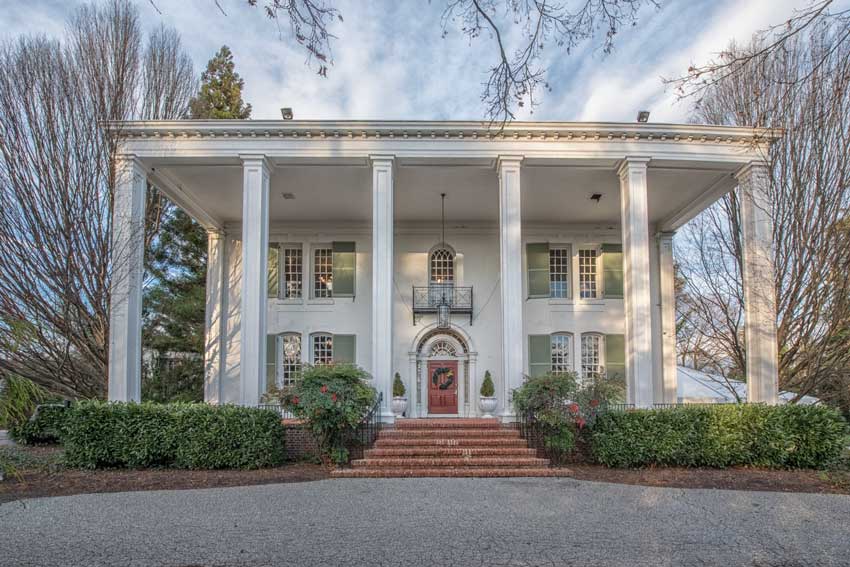
Photo credit:
Alex Cooper, 12/03/2018
|
Grey Rock Mansion
Inventory No.:
BA-39
Other Name(s):
Howard's Square; "Forrest"
Date Listed:
7/10/2023
Location:
400 Grey Rock Road (also known as 400 Clifton Court), Pikesville, Baltimore County
Category:
Building
Period/Date of Construction:
1923-1955
Architect/Builder:
Benjamin A. Frank
Boundary Description:
Property is an off triangle-shaped polygon. Starting from the most northerly point (93.28 feet North 42° 54′ 55′′ East [in degree minutes and seconds] from point 171 on the map) and then heading in the south-easterly direction and clockwise around the property, the border has four consecutively adjoining lines on slight angles, first heading South 46° 46′ 41′′ East for 100.89 feet, then heading South 05° 23′ 26′′ East for 90.51 feet, South 25° 47′ 43′′ East for 57.94 feet, and then South 00° 31′ 10′′ West for 142.51 feet. This then connects with the southern property border containing the front main entrance side, and such continues heading westerly bearing North 71° 30′ 48′′ West for 356.89 feet. The property’s western side border then heads north, which is composed of three sides, of which the first segment being 123.26 feet heading North 18° 29′ 12′′ East, then tangent an outwardly convex (on a 400.00 foot radius curve) segment for 170.54 feet arc length, being the only curved segment, then next tangent and heading North 42° 54′ 55′′ East, straight 93.28 feet connecting back to the starting point. (On a latitude/longitude system, 39.393719 N, -76.737510 W would be the estimated property center.)
|
|
Description:
Completed in 1861, the formerly Italian Villa-style Grey Rock Mansion was renovated in the 1920s to its current colonial appearance after a design by Baltimore architect Benjamin Frank for his client Ethel Epstein Katz. The former house, now used as a wedding venue, is located in Pikesville, Baltimore County, northwest of Baltimore City. The complex sits on a two-acre site surrounded by a condominium community. The 10,659-square-foot complex has an axial plan with the oldest section, a rectangular block, anchoring the south end. This historic core faces southwest with a three-story façade capped with a hipped roof. The façade is characterized by a full-length two-story portico reminiscent of Mount Vernon’s “piazza.” Attached to this at the rear is a line of historic wings and additions completing the house. Three smaller non-historic extensions are appended to the home. The home holds several principal rooms on its ground floor that were renovated or added to replicate 18th-century English manor houses and notable Maryland colonial homes. These architectural interiors are an important aspect of the house and its significance. The remainder of the rooms show a lesser degree of design and/or have been modified for the building’s current use.
|
Significance:
Grey Rock Mansion was originally erected in the late 1850s as an Italian Villa-style country house. In the 1920s Ethel Epstein Katz, with the help of architect Benjamin Frank, transformed
it into a colonial showpiece reflecting her wealth and tastes. As the daughter of a Lithuanian Jewish immigrant, Epstein Katz was born into a world of new money made by her father, Jacob Epstein. Epstein, who started as a peddler, later amassed a fortune as the owner of the Baltimore Bargain House — one of the largest clothing wholesalers in the region. Ethel grew up in a Georgian Revival-style mansion and transferred her interest in colonial architecture to “Grey Rock,” which she and Frank redesigned to emulate Mount Vernon’s famous “piazza” façade. For the interior, they worked to recreate rooms from historic English and American
18th-century homes. Both impulses were influenced by cultural trends in the 1920s: museum period rooms and measured drawings of famous homes. Grey Rock Mansion’s architectural
renovation was completed in the 1930s, with the interior work and landscaping continuing for more than another decade. The completed project served as Ethel Epstein Katz’s home until 1970. Grey Rock Mansion is significant as a superb example of architectural and design trends of the 1920s, particularly that of the revival of colonial architecture and historic furnishings. The period of significance, 1923-1955, represents the year the house was purchased through the conclusion of the project.
|
|
