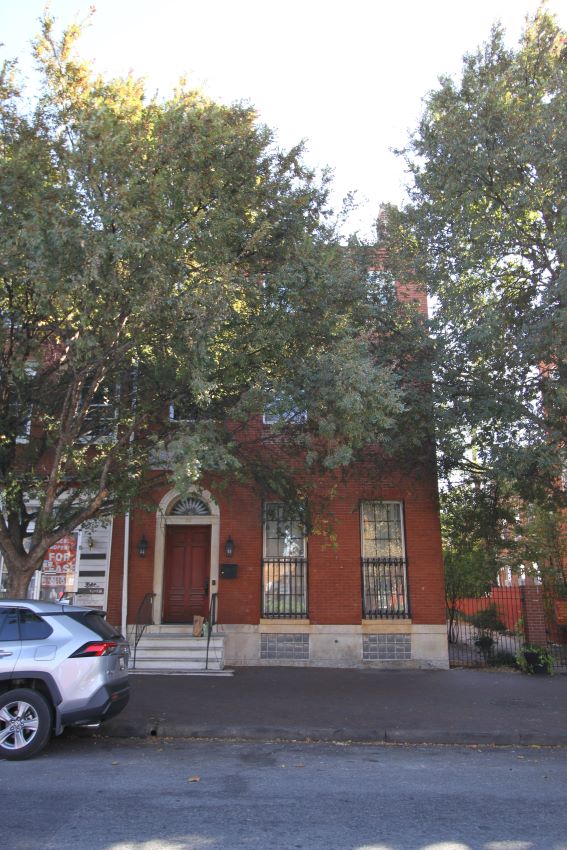
Photo credit:
Rachel Wilson and Christina Sabol, 2024
|
Baltimore American Indian Center and Heritage Museum
Inventory No.:
B-5123-2
Other Name(s):
American Indian Study Center, Inc.; Catholic Community House
Date Listed:
9/23/2025
Location:
113 S. Broadway, Baltimore, Baltimore City
Category:
Building
Period/Date of Construction:
1972-2011
Architect/Builder:
Edwin Robinson
Boundary Description:
The property is known as 113 S. Broadway and consists of the Baltimore City tax parcel Ward 02, Section 03, Block 1744, Lot 042.
It is described in the Baltimore City Superior Court (Land Records) Liber RHB 2958, folios 0756 as follows:
Beginning for the same on the east side of Broadway at the distance of one hundred and twenty feet southerly from the southeast corner of Broadway and Lombard Street and running thence southerly bounding on the east side of Broadway forty-one feet one inch to a division fence there situate thence easterly one hundred and forty four feet ten, and one quarter inches to the west wall of the warehouse fronting on Register Street thence northerly bounding on the west wall of said warehouse forty feet nine inches to the end thereof to intersect a line drawn easterly from the place of beginning parallel with Lombard Street and thence westerly reversing said line so drawn and bounding thereon one hundred and forty five feet five inches to the place of beginning.
Related Multiple Property Record:
American Indian Heritage in Baltimore City, 1885 to Present (2025)
|
|
Description:
The Baltimore American Indian Center and Museum sits on the east side of S. Broadway, in the Upper Fells Point Neighborhood of the City of Baltimore, in Maryland. The three-story building is one of a pair of circa-1843 rowhouses with a shared wall. A south side gate provides access to a small courtyard. The Greek Revival style, structural brick building, laid in a 1:7 American Bond, has a stretcher brick veneer on the west facade.1 The Upper Fells Point area originally developed circa 1840 and includes a wide variety of architectural styles.2 The rowhouse has undergone multiple modifications. The semi-circular fanlight has been modified to include American Indian motifs. The rowhouse has a three-story back building and a circa-2008 east addition.
|
Significance:
The Baltimore American Indian Center and Heritage Museum is significant for its association with the migration of citizens of the Lumbee Tribe of North Carolina and their development of a vibrant, intertribal American Indian community in the post-World War era in Baltimore City. Specifically, the Center, initially established in 1968 and later housed at 113 S. Broadway beginning in 1972, has provided American Indian and Alaska Native residents of Baltimore (the majority of whom have been and are citizens of the Lumbee Tribe of North Carolina) with social programs, cultural events, and assistance with transitioning to life in Baltimore and celebrating their respective cultural identities in diaspora. The Center is associated with important American Indian community leaders, the three co-founders of the Center, Elizabeth Locklear (Lumbee; 1928-2019), Rosie Hunt (Lumbee; 1941-2007), and Herbert Hoover Locklear (Lumbee; 1932-2000). The Center is locally significant starting in 1972, when the Center acquired the building at 113 S. Broadway, to 2011, when the museum was established at the Center, solidifying the Center’s range of services still offered today as well as its current official name. The Center continues throughout this period, and to the present, to be the physical location for sustaining the social and cultural traditions and identity of the Baltimore American Indian community and playing an active role in assisting community members with social programs and public educational events.
|
|
